Click on the links above for information and recipes about these crops.
COMING SOON:
Fava Beans
Green Beans
Cucumbers
Sweet Onions
Carrots
Every morning, and sometimes throughout the day, I pinch myself. I just can’t believe it’s really summer! But it must be, because we have so many peas, the squashes (including zucchini) are in full bloom, the beans are blooming, the herbs are growing, and there are lots of vegetables showing now in colors other than green!
The first to bloom are the Shirley Poppies and Bachelor’s Buttons. There are many more though.
If you haven’t yet, I urge you to come and help yourself to the u-pick peas. There are Shelling Peas, and Sugar Snap Peas, and you can take as much as you want to pick—for free. Yes, they are FREE, so get down here and pick some to eat, or to eat and freeze for later, when you need a taste of summer. Many people just pick a handful, but it makes me SO happy when I see people come out of the burgeoning rows with big bags bursting with peas! You can easily pick $50 worth of sugar snap peas, for FREE! I’m sure there will be peas for one more week, but if it gets hot they won’t last more than two weeks.
Now is the time to pick a huge armful of flowers in the U-Pick Flower Garden. Take a lot!
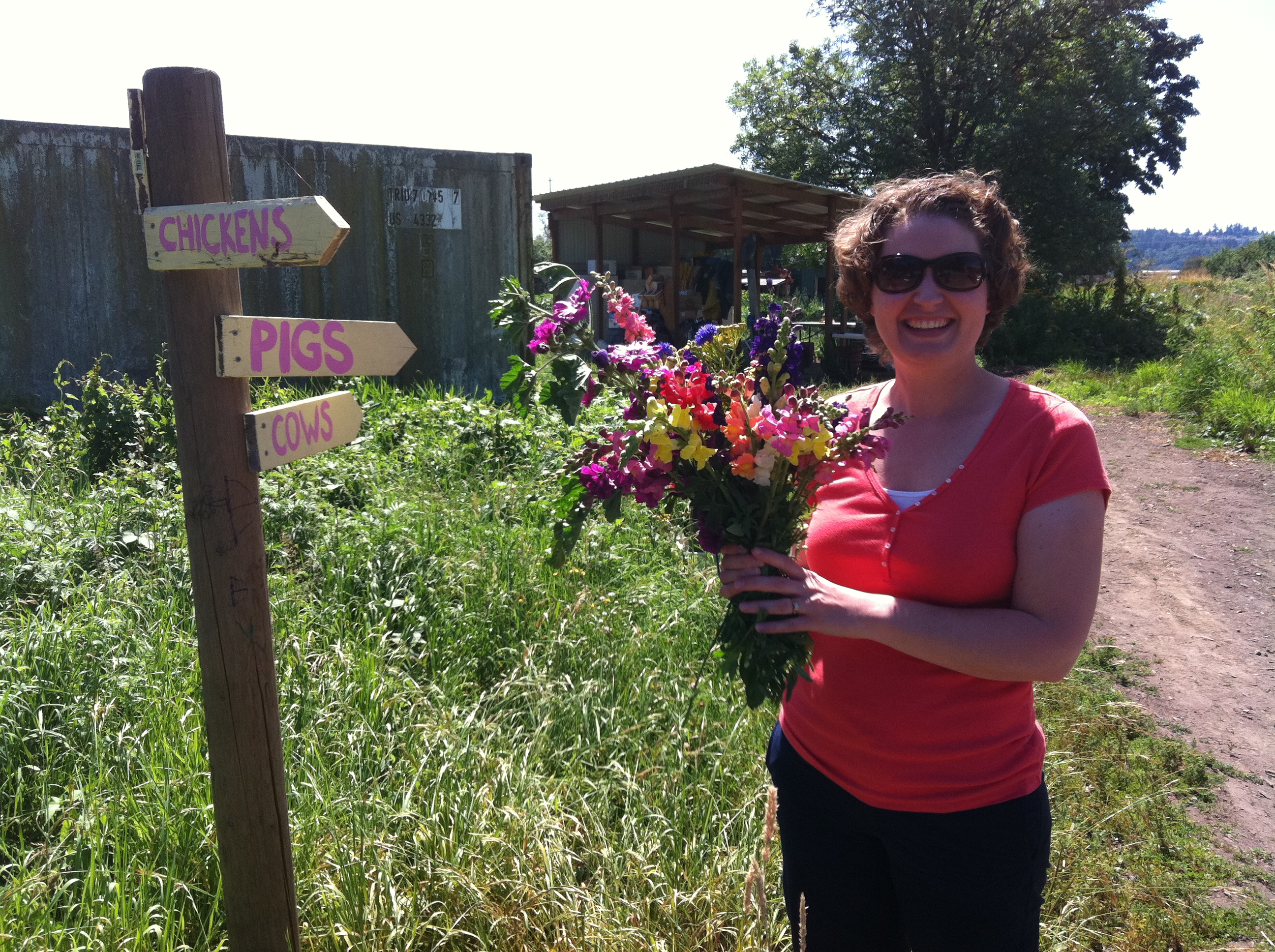
Something else to take advantage of is the U-Pick Cutting Garden. We plant all these beautiful flowers, and weed and water them, just for you—our loyal subscribers! So please come down and get a HUGE bunch of blooms. Kim here did herself proud and got enough for FOUR VASES! It makes me so happy to see people enjoying them! See my separate post about cutting flowers here.
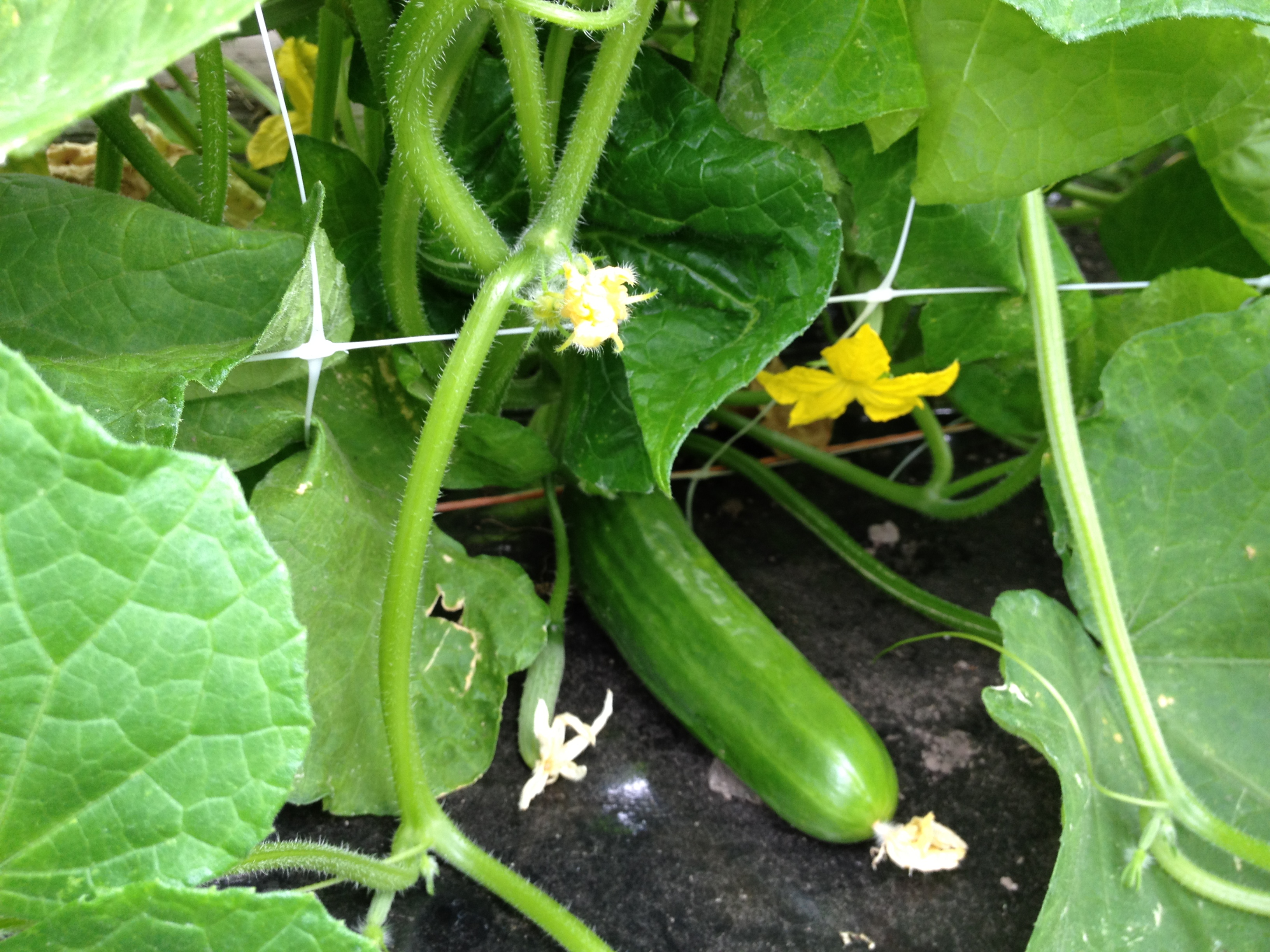
It’s been about 10 days since I pruned and trained the cucumbers, and look what’s happened! The vines are spilling everywhere. I had to do serious pruning today just to get in. There are so many little fruits though! We’ll be rolling in cukes soon!
The zucchini were blooming this week, and we actually did scrounge to get enough to give everyone two tiny zucchini, but don’t fear, there will be more. I ate my first green bean today, and while there aren’t many yet, there will be soon. The cucumbers are spilling off of their trellises now, and they are covered with 2-3″ fruits, so it really won’t be long until they are ready, as well as the new cilantro and dill crops. Just in time.
The poor hens that I wrote about last week are still traumatized, and are coping with a serious case of PTSD. We try to be calm when we go in to feed or collect eggs, but even that sends them into a panic. The mink really did a job on them—and we lost 30 hens. Mike did a head count the other night to get a tally. We started with 100 in that flock, so we are down by one-third.
The last of the summer crops are going in this week, as well as the first of the winter crops. July is the peak of busyness around here. Long days make for good sleep.
A happy customer with her beautiful bouquet from the u-cut flower garden. Nice job!
After walking a few people through the cut-flower garden today, I thought it might be a good idea to share some information on how to choose flowers for cutting.
First, here is the entrance to the cut-flower garden of 2011. Please stay on the path, and proceed to the center archway to find the individual flower rows. Please don’t pick from the pathways because I have little marigolds planted there, and you’ll actually have a better selection if move between the rows.
The most important thing to avoid are flowers that have already bloomed. It’s ok to have some instant gratification, but you really want flower buds that are JUST ABOUT TO BLOOM. You want to see color, but not a fully-open flower. Open flowers will not travel home well, they will wilt quickly, and they will not last long once they are home. However, stems still in-bud will travel well, and will greet you tomorrow morning with a cheery, perky blossom.
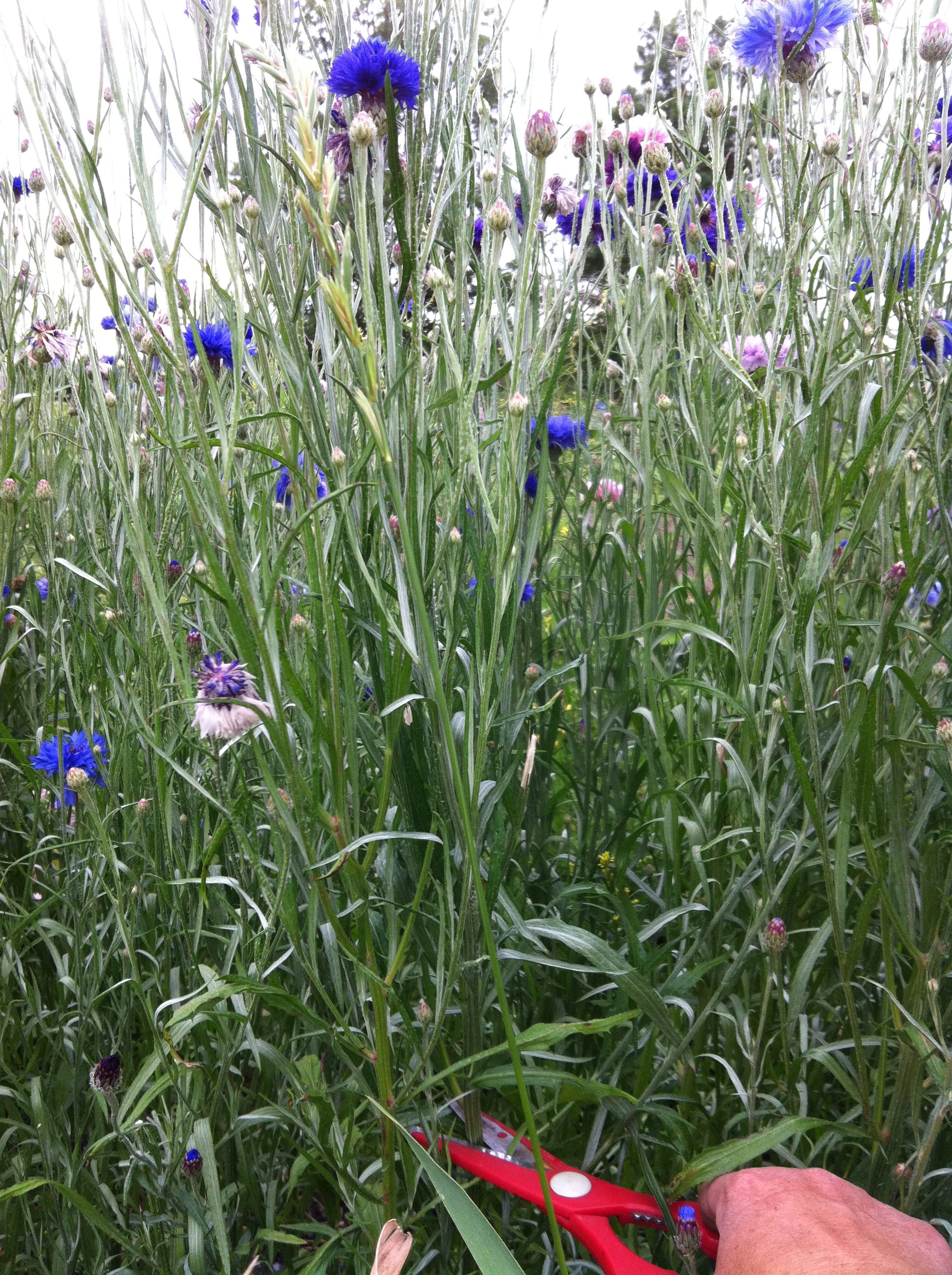
The next most important thing is where to cut on the plant. I see people trying to be sparing with the plant, cutting a single stem, way up high. You want to bend down and find a major joint on the stem. You can always trim them up when you get home, or even after you get all the stems collected. Not only will this give you a full bouquet, but it will make the plants produce more buds and blossoms. You are pruning the plants while you cut flowers. You will not hurt the plant, you will actually encourage it to make more stems and flowers.
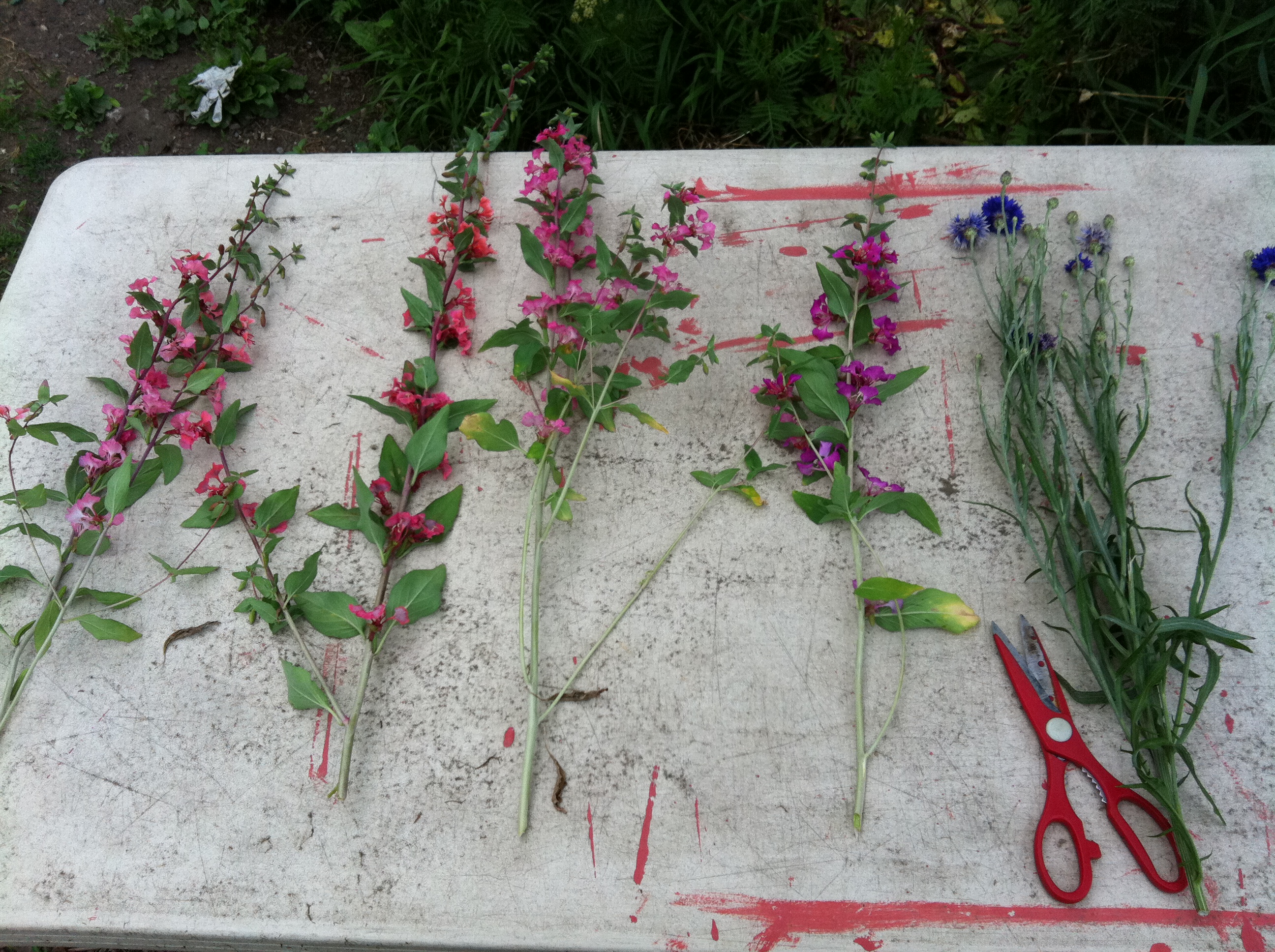
This is what you want to take home—long, stems with lots of buds and just one or two open blooms.
Once you’re finished cutting, keep the flowers cool, fill a bag with water if possible, or wrap wet paper around the stems to keep them moist. Then, when you get home, fill a vase (or jar, or glass) with warmish water and RE-CUT the stems before you put them in the water. While in transit, the ends of the stems will dry up some, and they won’t be able to suck up much water, which will make them wilt and die sooner. A fresh cut invites water into the stem.
After you get them home, you can cut the rough bunches into tidy stems so that you can arrange them thoughtfully.
Cut lots of flowers each week!
SPECIAL NOTE ABOUT POPPIES:
It’s especially important to remember not to cut poppies if they are open blooms. They must be in full bud, with just a hint of color peeking through or they will not open and last. You also need to do one more step: after you get them home, re-cut the stem and burn the end with a match, torch, or stove burner. This seals the sticky, milky sap and prevents the stem from clogging up. If you don’t burn them, they will quickly wilt and die, a sad and preventable fate.
Great things are happening on the farm. Summer squashes are blooming, and soon there will be enough to pick for everyone. That is, more than a small basket. It takes more than that to feed 100 families, but it won’t be long. The peas are finally ready, and we’ve opened up the u-pick peas for all subscribers. Please come and take advantage of this part of your CSA share while they are in season—it’s usually not more than two or three weeks before they dry up in the July sun. We hope you’re enjoying your share so far—we’ll be bumping up the quantity very soon!
For the last few weeks we’ve noticed strange happenings in our young hen house. About once every two weeks a chicken has died—we have just been finding a dead hen in the morning. No real signs of injury, other than other chickens pecking at it. (Chickens are omnivores, not vegetarians, and will readily take part in animal protein. They’re not very discriminating, either.) We remove the body and ponder the causes. For a while it was only Auracanas (the hens that lay blue eggs)—maybe something was wrong with that batch of hens? None of the birds have been acting sick or injured.
A trail of barred chicken feathers through a planted field. There are no footprints, so apparently a hawk caught a chicken and flew over with it.
There is a Red Tailed Hawk nest next door—their nest tree across the street was cut down over the winter, so they moved to our side. We have lost a hen or two outside, and the hawks have been diving around the chickens, so it’s easy to blame them, but why wouldn’t they take the bodies? And they wouldn’t have gone in the chicken house anyway.
There are all kinds of critters that are supposed to live around here. They are on the maps, in the guidebooks. Skunks, Raccoons, Opossums, Coyotes sure—we’ve seen and/or smelled them. There are also many that are supposed to live around here that we never see—foxes, for example. Occasionally we see a weasel, and this year we’ve actually seen a few, mostly up by the big locust tree by the road. Weasels aren’t necessarily bad. They enjoy rodents, and are proficient hunters of rats because they easily fit in the rat tunnels, and they’ve never done any damage. We do have a rat problem here—between the river and the spilled grain at the feed mill down the street, it’s hard to stay on top of them. So, we’ve been hoping for a weasel family to take up residence and assume control, and they did. Haven’t seen a rat around the cow barn in months, and that IS a good thing.
But then, there are mysteries. Mike and I were doing chores Friday morning when two fuzzy black weasels crossed the driveway in front of us. They were not afraid of us, and had been visiting the big chicken yard behind the house. I tried to get a picture, but they were too quick. Then Mike yelled from the chicken house, “There’s another one coming!” So I got my camera ready, and waited for it to leave the chicken waterer and follow the other two.
I thought weasels were supposed to be rusty brown? Google on the iPhone is an amazing thing, because I soon learned that they were Mink. Yes, North American Mink are native here, before there were Mink farms. Now, it’s common to find Mink when animal rights groups release them from their cages at fur farms. This causes all kinds of havoc, for natural wildlife and for farms. They may be cute and fuzzy, but they are vicious, with few enemies. They can scare off a coyote or hawk. Michaele, at Growing Things Farm in Carnation said that there was a huge release of Mink by her old farm, and they just kept losing chickens. They never could get control of the situation until they moved to another farm. In the natural state of things, there just aren’t many, I think, or they’re not often seen. Regardless, we had a family. I was excited—no more rats! They were cute, a novelty! New wildlife!
It took us until Saturday morning to put all the pieces together. Four more dead hens Sunday morning, in the chickenhouse. Why were those old rat tunnels so clean, opening up into the chickenhouse? How long have the chickens been acting so frantic and terrorized? Hmmm. I looked up videos and more weasel/mink information. I found this, and it all became clear:
The mink had to go. (It is a weasel in the video, but a mink does the same thing, they’re just bigger.) They kill the chickens by attacking from the back and clamping their razor teeth onto the back of the head. We found not-quite-dead hens with their necks shredded, or brain-dead. Nothing could be done to rescue them.
Monday morning there was another dead hen in the chicken yard. Tuesday morning two more. Wednesday morning, two small mink killed three chickens inside the house while Mike was standing outside. What could we do on a market day? No time to babysit chickens. I was at the Columbia City Market when Mike called me to report that he had shot the big one, and Cosmo had shot two little ones. We felt that the hens would be safe, finally.
They look cute, but we have learned a lot about Mink lately. They are ferocious killers, and they kill for sport, not just for food. It’s even worse when you have a mama teacher her three pups how to kill.
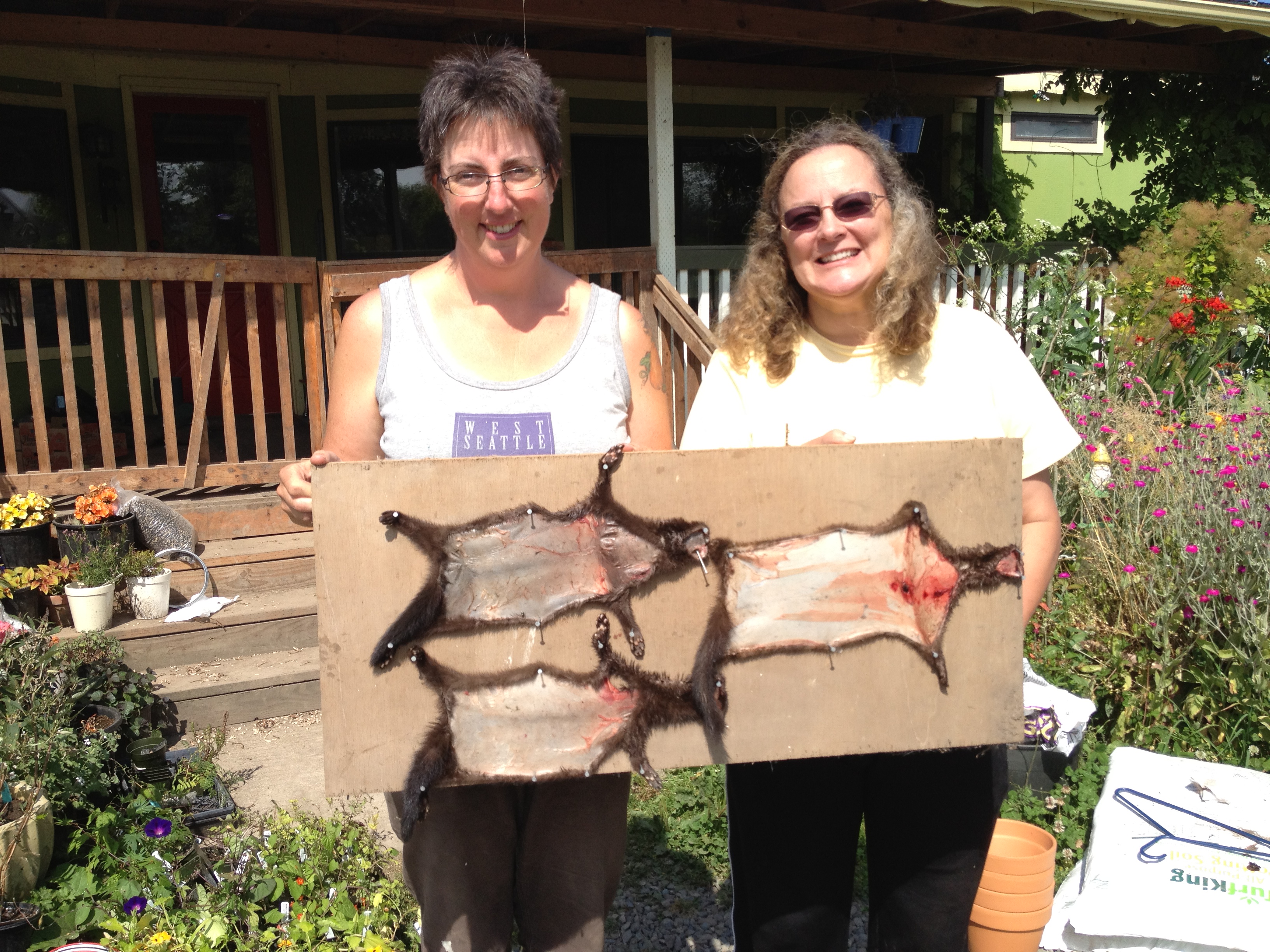
Thursday morning, no dead hens. My friend Cathy came over to learn with me how to skin them. Why waste good mink pelts, right? When I did the mama mink, I noticed three teats, not just two. There must be another one out there. Sure enough, it was sneaking into the chicken house and about to pounce on a hen when Mike got it. Hopefully that it is it.
Why let good pelts go to waste, when you can have a learning experience instead? My friend, Cathy and I learned how to skin Mink, and hopefully will successfully tan them as well.
I have always believed in the ecosystem of the farm. That means embracing the predators and pests, as well as the crops we’re growing. However, there is a line that has to be drawn. I was willing to make a sacrifice of a hen or two every couple of weeks in exchange for rat control. But four hens a day is not an acceptable loss. Soon there would be no hens, and no eggs. There is a huge investment in egg chickens—six months of nurturing before they even lay an egg. We can’t afford to lose very many.
Brazen destruction is not allowed, whether it is a massive flea beetle infestation in the arugula or a pack of coyotes traipsing through the backyard taking cats and baby chickens home for dinner. There is a balance to maintain—supporting the hawks for the short term (with an occasional chicken) means that there will be a predator base to keep the rabbit population under control next year. But there is also a tipping point to steer away from—a point of no return.
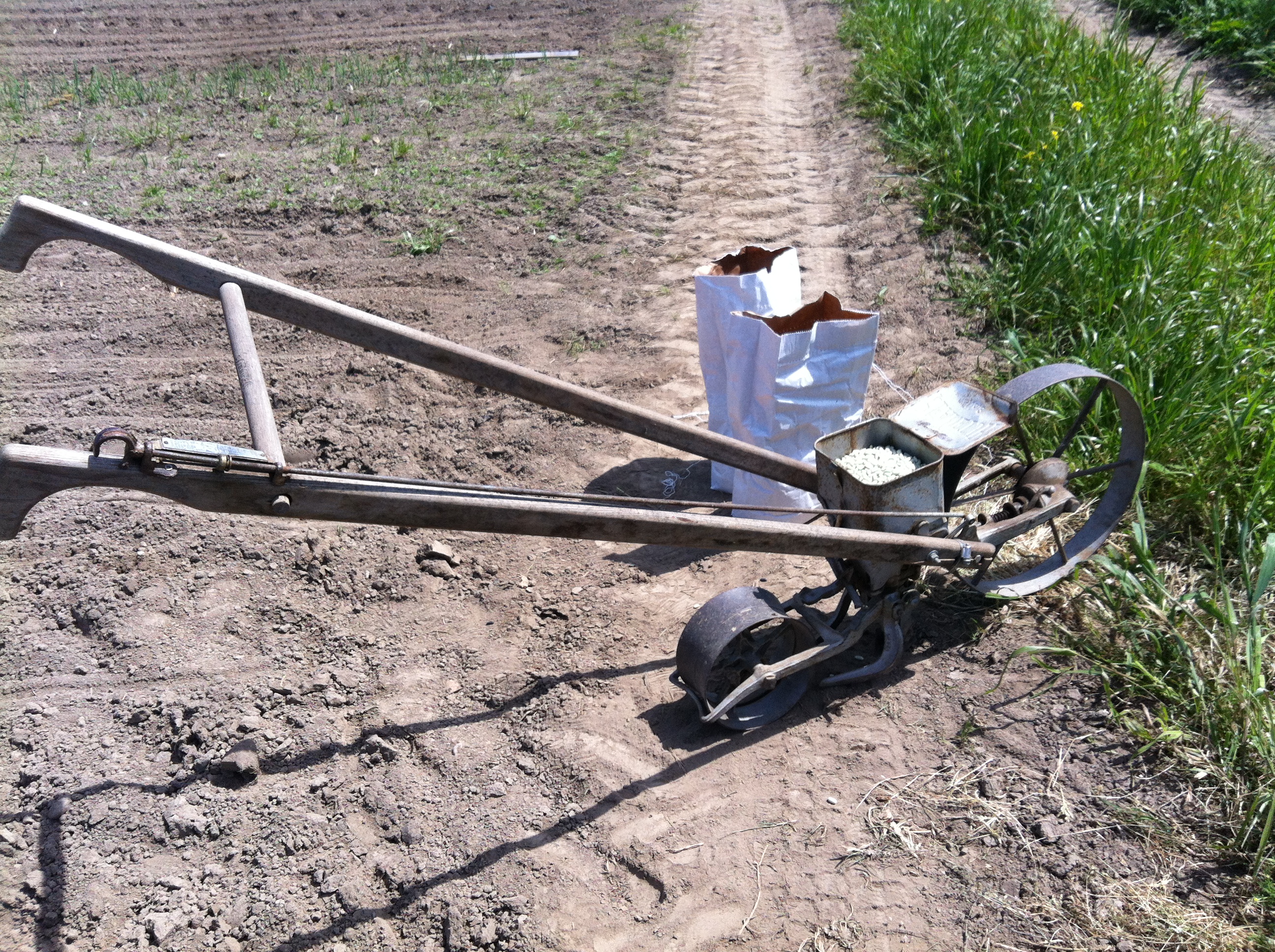
This is the spacing adjustment on the Planet Junior hand planter. The little dial spins up the threaded rod to adjust the opening at the base of the planter and let more or less seed out of the chute. I like the examples of seed sizes, from a different time, when Parsnips and Salsify were common vegetables.
THIS WEEK’S SUBSCRIBER MENU:
• Salad Mix
• Stir-Fry Greens
• Spinach
• Collard Greens or Pea Shoots or Lambsquarter
• Beet Greens or Cilantro
• Fresh Garlic
Click on the links above for information and recipes about these crops.
Last week was prime for planting. It was cool, but dry, with the promise of a good rain, followed by a good warm spell. We replanted the beans, pickling cucumbers, and summer squashes—something ate half of the rows, or they rotted. Hard to say which.
This is the Planet Junior hand planter that Mike’s dad used for planting their Southcenter farm. Still in operation, but the wood handles have been changed. It works great for everything except the tiniest of seeds.
I used the old Planet Junior to plant by hand certain crops—the third planting of bush beans, some more shelling beans, and parsnips and salsify for winter. The Planet Junior doesn’t have set apertures, so it lets odd-shaped and large seeds fall out easily. I also used this to get the corn planted. (Yay, corn this year!)
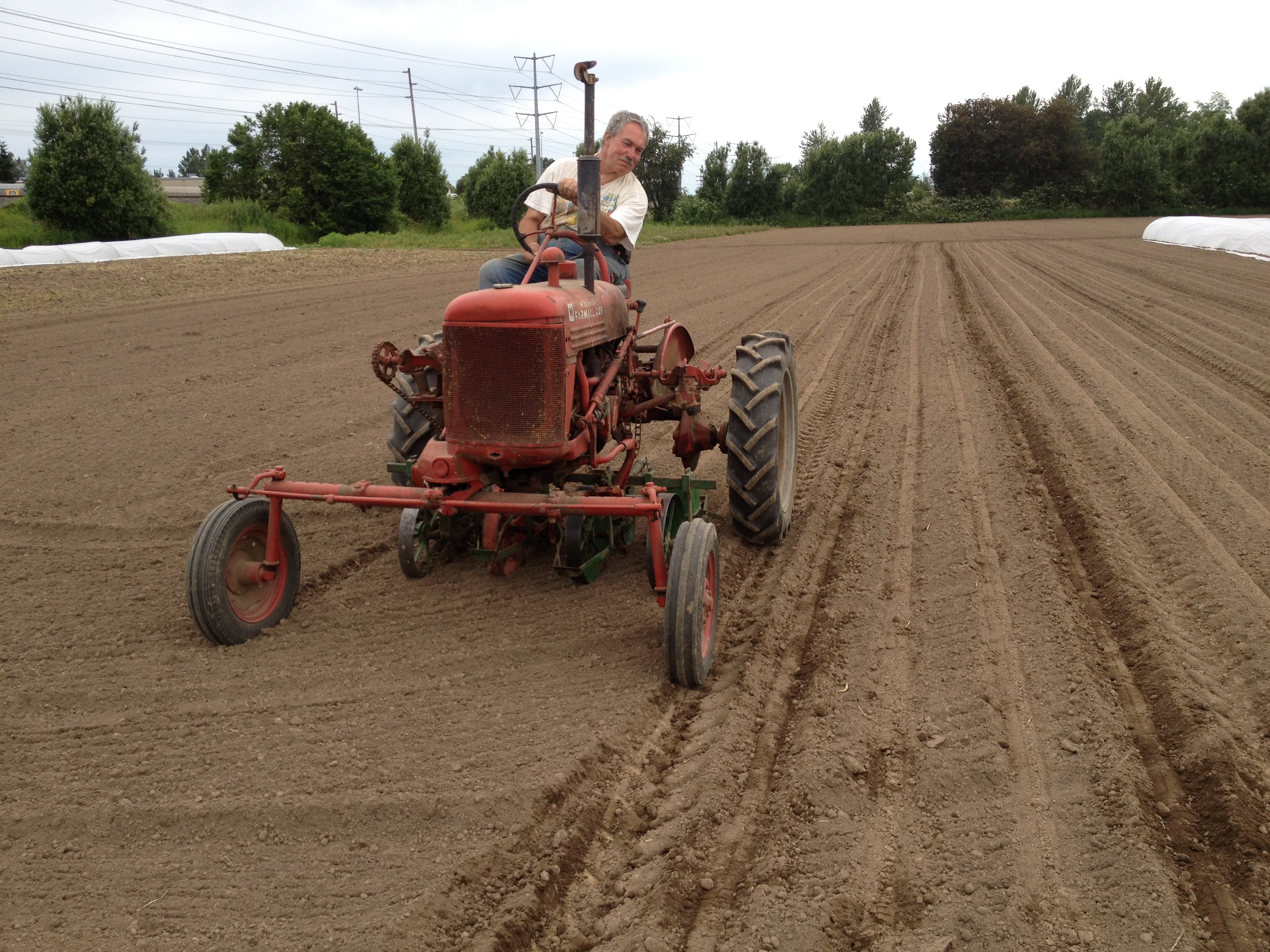
For most row crops, except large seeded things like corn, peas, squash,etc. that need lots of space, we use the 1941 Farmall Cub with belly-mounted Planet Junior planters. This way we plant four rows at a time, and calibrate the cultivator implements to the same spacing to eliminate some hand-work.
Mike used the 1941 Cub tractor with belly-mounted planters to sow the uniform seed crops—another sowing of dill, cilantro, and spinach, more beets, chard, and kale, and some kohlrabi, purslane, and odds and ends. These planters use set seed measurements so they make for even, uniform sowing.
We also finally got the winter squashes and pumpkins planted, and Mike started making beds for cauliflower, broccoli, and the BIG planting of basil.
Things are looking good for next week. The pea plants are loaded, both sugar snap and shelling peas, and we’ll be able to open the u-pick area. The new carrots, turnips, and arugula are looking great, and the cucumbers are blooming like crazy. Even the tomatoes are kicking into gear finally. Summer is finally on the way!
Email is the best way. We’re outside much of the day so it’s difficult to return phone calls. But, if you are happy to talk to an answering machine, you can call (253) 859-5197.
Farm Address:
Whistling Train Farm
27127 78th Ave. S.
Kent, WA 98032










 Whistling Train Farm