
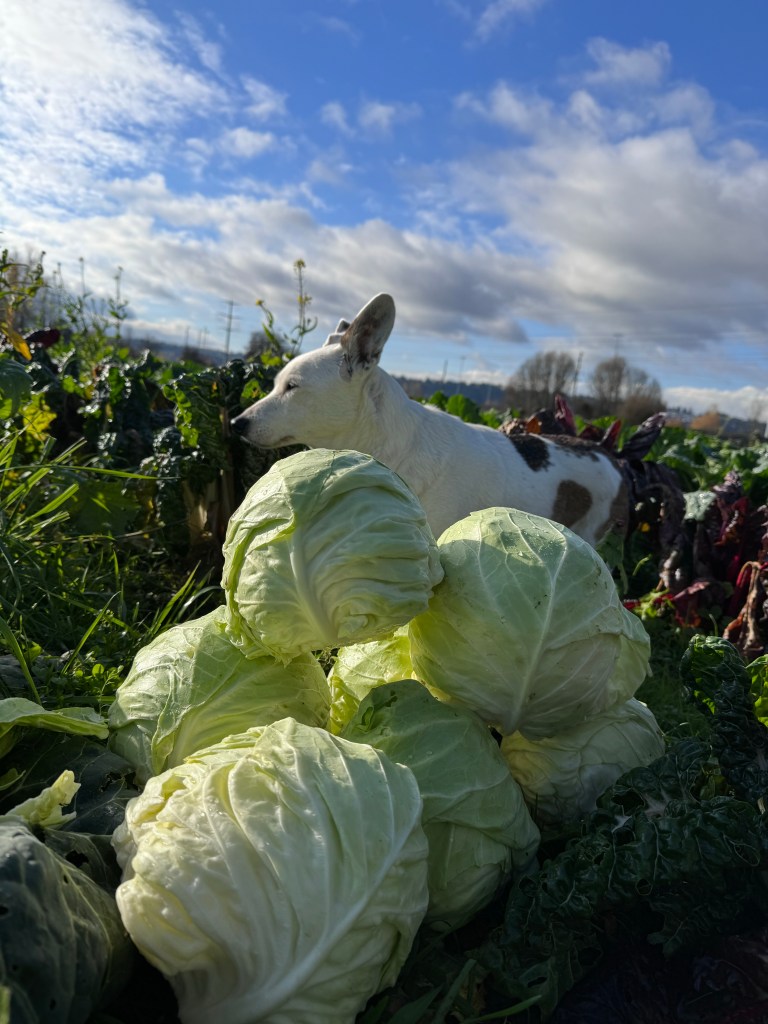
The 2023 farming season is winding down, the skies are getting darker and the days are getting colder. It’s a relief to be entering the season of rest. It is the time of roots and greens, and the cold makes them taste even better, even if it makes them more difficult to harvest. It’s my favorite time to eat vegetables, honestly. Not only are flavors more concentrated and the greens sweeter and less bitter, but I actually have the time to make FOOD, instead of the grazing days of summer.
It’s been a frosty, frozen week, and while the greens that can tolerate it are still alive and well, they can’t be harvested while frozen. You see, there is a constant ebb and flow of water and sap throughout the tissues of plants. When it is warm, sap and water flow upwards from the roots to the leaves, and when the air starts to freeze, the plants do their best to push much of that water down to the roots where it can’t cause as much damage. When the air freezes, the water inside cells turns into tiny icicles which can puncture the cell membranes, causing cell death. That’s why non-hardy plants look black and wilted, as if they are cooked (looking at you, Dahlias). But the more durable plants turn some of their starches into sugar that acts as antifreeze, so the cells don’t get punctured as easily by ice. However, if they are harvested while all their water is in the roots, they won’t recover and perk up, so it’s best to wait until the air temperature warms, and the plants are circulating liquids again.
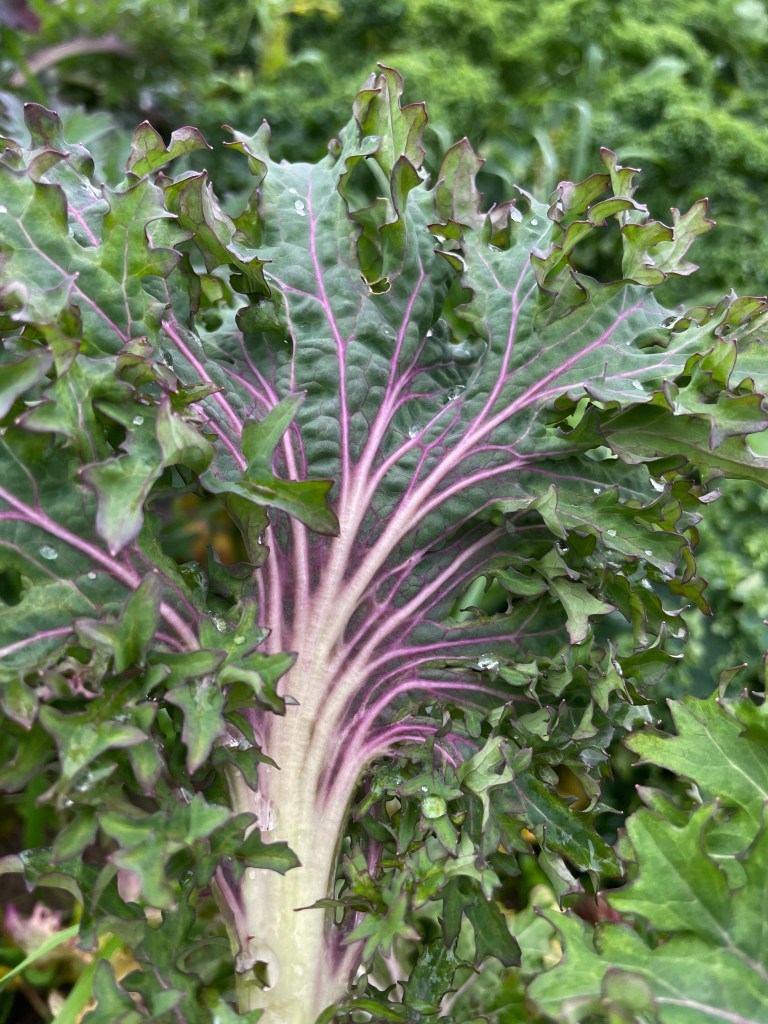
That’s why, when we have a freezing stretch, there aren’t as many greens in the CSA harvest. More roots and storage crops make their way into boxes. But we’re warming up a bit in the next week, so greens will return. At least for the next few weeks; the final week of the CSA season is just before Christmas. And then I’ll begin strategizing for 2024.
On another note, the Trumpeter Swans have returned from the Arctic summer! We don’t get many in this valley, but it’s reassuring to have them back. I hear them tooting overhead while picking greens, their long, white bodies glide through the silvery fog, and all is well. At one time, prior to the invasion of agriculture and development, the Green/Duwamish River Valley was a major stop on the Pacific Flyway, one of the north-south bird migration corridors. A wildlife biologist who birds here somewhat regularly told me that this entire valley used to be a complex of braided streams and wetlands, and that huge flocks of ducks, geese, cranes, and swans, as well as songbirds passed through. Imagine the sounds! So when the clumps of swans and geese fly over, that’s what I try to imagine. Tens of thousands of birds in a raucous flock, gathering, circling, landing, talking, and eating.
I’m excited about the small and simple CSA of 2024. A smaller growing space will be much easier to manage, and hopefully I’ll be able to keep on top of the weeds in the cut flower garden. A more intimate CSA project awaits, and I am here for it. With fewer families to serve, I can plan for more u-pick opportunities for those who want that. Also, several people have asked about the Pantry-Builder Subscription, and I am considering offering it again in 2024. It’s not a lot more care or harvest time to plant more pickling cucumbers, green beans, and sauce tomatoes. And I’m already planning how I’ll reinforce the Sugarsnap Pea greenhouse to battle the bunnies.
While I was picking kale and baby boy choi on this beautiful, sunny morning, I looked out into the field, filled with singing sparrows. Next year, most of the fields will be cover-cropped with species loved and needed by pollinators. I’m excited to see what changes come to my property if I don’t work it so hard. It’s already an Audubon birding hotspot… maybe even more species will visit. I’m looking forward to doing more in-depth surveys of insects here, expanding on what I’ve done in the last two years. Last year alone, I logged 156 species of moths. And my pollinator survey was haphazard, but will be more focused in 2024. Insect diversity is the key to a healthy ecosystem. If I can create a rich, diverse habitat on my 15 acres, how might that change, and possibly inspire, managers of other farms and open spaces.

This is my vision for 2024. 15 acres of healthy, healing ecosystem surrounding 1-2 acres of vegetables production. Let’s see what happens!
My 2024 Little CSA is filling up, but there are still a few spots available. Share pickup is on-farm only, but two Seattle groups have organized a “share-pool”, where members take turns picking up for everyone at a drop-site. Right now, these share-pools are happening in Greenwood/North Seattle and West Seattle, in addition to our long-time Burien share-pool. Pickup is still at the farm, Saturdays and Tuesdays, and everyone is welcome to cut flowers while in season and visit the pumpkin patch and sunflower field.
It’s been an interesting farm season, but it’s finishing up strong. I’d love to have you join me in 2024.
Here is the link to the new online farm store, where you can register for 2024 CSA. And the contacts for the share-pools are below.
Whistling Train FarmStore Click this link to purchase 2024 CSA Shares and/or Pantry Builder Subscriptions
Contact for North Seattle/Greenwood CSA SharePool: Jonathan Betz-Zall at jbetzzall@yahoo.com
Contact for West Seattle CSA SharePool: Rose Ragan at rose.ragan@protonmail.com
If you would like the contact for the Burien SharePool, please email me.
With much gratitude,
Shelley


 Whistling Train Farm