Category Archives: Uncategorized

Summer Week 9: Some Like It Hot

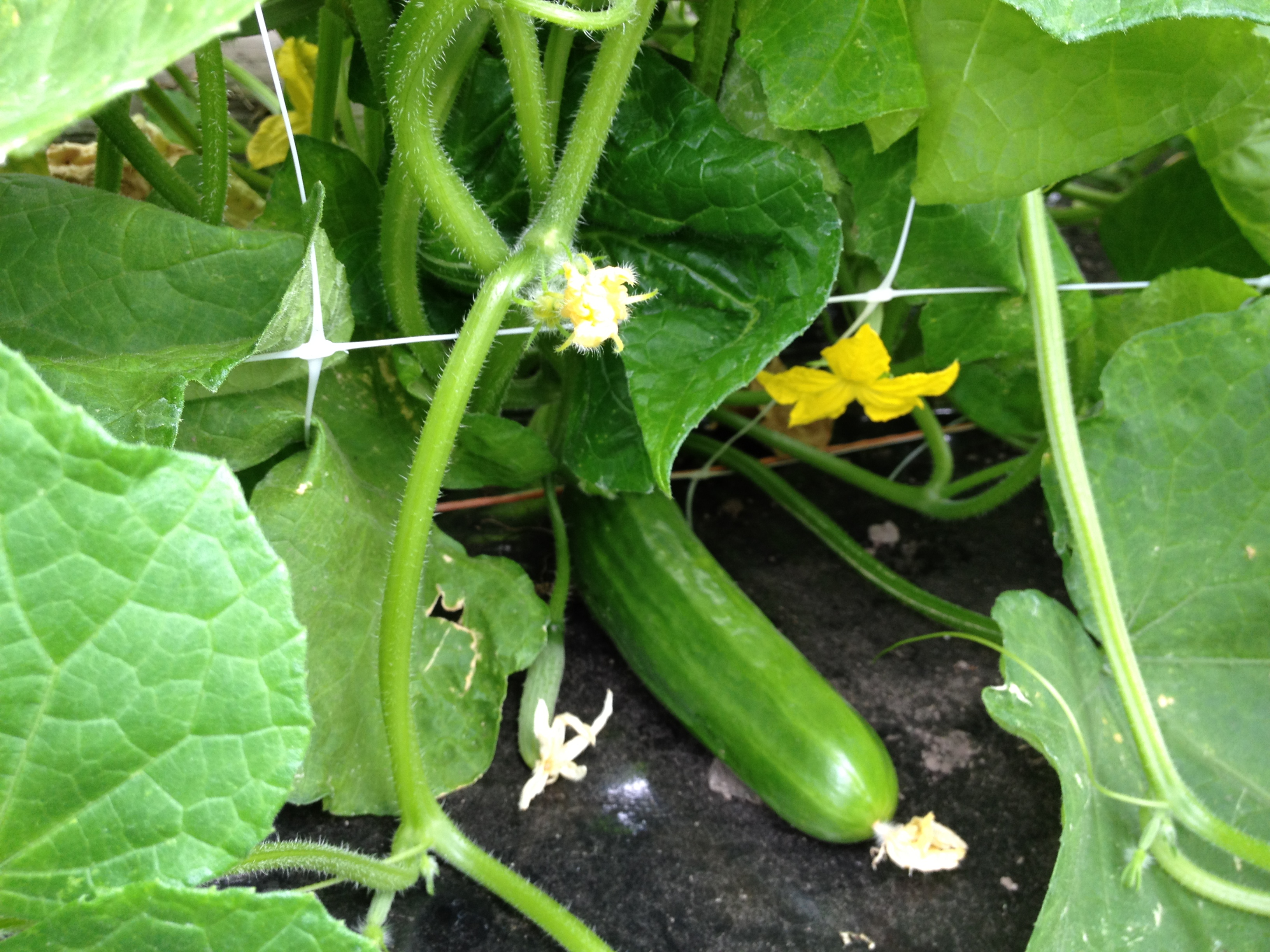
In the greenhouse, trellised cucumbers dangle from the netting supports like Christmas ornaments.

THIS WEEK’S SUBSCRIBER MENU:
• Little Lettuces
• Fava Beans
• Zucchini or Summer Squash
Beet Greens with Baby Beets
Cucumber
• Fresh Cilantro
• “Romanian Red” Garlic

Click on the links above for information and recipes about these crops.

COMING SOON:
Carrots
Cabbage
Basil
Green Beans
Romano Beans

There are always crops that fail when the weather is cold and rainy, like last year—tomatoes, peppers, melons, etc. But what about when the weather is hot like it is now? The lettuce bolted quickly, and so did the spinach. But in the last two weeks, the squash, cucumbers, and tomatoes have gone into overdrive. We are especially inundated with cucumbers, so I am encouraging everyone to take as much as they want. How many years can we say that? I think in last year’s dismal summer we might have picked cucumbers for about two weeks, but that’s not the case this summer. So, in that light, I have found some interesting recipes to help you make use of the juicy, fruity vegetable.

Cucumbers are in the gourd family, with its cousins the squashes, melons, and pumpkins. They are native to the Middle East—especially what is now Pakistan, where the Indus River makes the dry ground fertile and muddy. The original species of cucumber had smooth, brownish skin and very bitter flesh. Seed Savers Exchange carries a variety called Poona Kheera that is similar, with russeted skin like a potato, but  sweet flesh. Time and human intervention sweetened the skin and changed the skin color to green. The Ancient Greeks considered the cucumber to be Ambrosia—food from the gods—and mixed the pulp with honey, serving it only on special occasions.

The Romans were addicted to the cucumber. The Emperor Tiberius ate at least ten each day, year round. They stole them from the Greeks. The Macedonians took plants from Persian war ships in the battle of Granicus. The Persians had already stolen seed from the Medes, who brought the fascinating object to Babylonian gardens as a souvenir from India.

Originally, the cucumber came to Europe as a palliative plant, planted in vineyards to protect the grapes from insects. It took 50 or so years until someone finally discovered that they tasted good. Charlemagne declared that cucumbers were his favorite fruit, and he ate them as dessert, in sweet tarts and custards.

There is really no difference in the green cucumbers we have today. Many people prefer to eat “pickling cucumbers” in their salad, and I know several people who pickle the smoother “slicing cucumbers”. They are all tasty, and nutritious. And they are all as refreshing as they are prolific in hot weather, so eat up!

CUCUMBER WATER
Cut up a cucumber into small chunks, cover in the amount of water you want to drink and let it soak in the fridge overnight. In the morning, strain the mixture and discard the cukes. Mint makes the drink even more cooling and refreshing. If you add mint, chop the mint and let it soak with the cucumber chunks in the water overnight. You can add a squeeze of lime before serving, or place a half lime in with the concoction you’re soaking overnight.

When all is said and done you’ve got a subtly flavoured, refreshing beverage you can serve over ice. It’s surprisingly addictive, so make a bunch or it’ll be gone in no time.

CUCUMBER MARGARITA
1/4 cucumber, peeled, sliced, seeded, and diced
1 lime, juiced, plus a wedge or slice, for garnish
2 ounces tequila reposado
1-ounce simple syrup or agave nectar
1-ounce sweet and sour mix
Pinch cayenne pepper powder

1. In a cocktail shaker muddle cucumber, add ice, lime juice, tequila, simple syrup, sweet and sour mix and pepper powder. Shake and serve in a rocks glass with salted rim. Garnish wtih a wedge or slice of slime.

2. Garnish with a wedge or slice of lime.

CUCUMBER SOUP
5 cucumbers
1/2 cup chopped parsley
6 scallions, chopped
2 tablespoons chopped fresh dill
1/4 cup fresh lemon juice
1 quart buttermilk
1 pint yogurt
Salt and freshly ground pepper

1. Peel cucumbers and cut them in half, scraping out seeds. Sprinkle the cucumbers with salt and let them stand 30 minutes. Drain excess water.

2. Chop the cucumbers coarsely and put the pieces in the blender along with scallions, dill, lemon juice, buttermilk, and yogurt. Blend at high speed. Season with salt and pepper to taste. Chill well before serving.

CUCUMBER RAITA (Indian Cucumber Yogurt Sauce)
1 medium cucumber
1 teaspoon cumin seeds
2 cups plain, whole-milk yogurt
1 clove garlic, peeled and minced
2 tablespoons fresh coriander or mint leaves, chopped
cayenne or paprika to garnish

Peel cucumber. Cut lengthwise into 1/4-inch strips, then into thin slices crosswise. Blot off moisture with paper towels. Toast cumin seeds for a few seconds in a small, heavy frying pan over high heat. In a bowl, stir yogurt until it is smooth. Mix it with the cumin, garlic and coriander or mint leaves. Combine mixture with cucumber slivers, sprinkle with cayenne or paprika, and chill before serving.

CREAMY CUCUMBER SALAD
2 Cucumbers, about 7 inches long
1/2 tsp. Salt
2 1/2 tbsp. Cider Vinegar
1 tsp. Sugar
1 cup Sour Cream or Plain Yogurt
1 small Shallot, minced
1/2 tsp. Celery Seed
1 tbsp. chopped Chives or Green Onions
1/4 chopped Fresh Dill
Salt and freshly ground Black Pepper

1. Peel the cucumbers, if desired. Cut into thin slices and place them in a large bowl. Sprinkle the cucumber with 1/2 tsp. salt, 1/2 tbsp. vinegar, and 1/4 tsp. sugar. Gently toss and let stand 30 minutes. Drain, gently pressing out liquid with the back of a spoon. Pat dry with paper towels.

2. Meanwhile, place the sour cream in a medium bowl and whisk until light. Whisk in the shallot, the remaining 2 tbsp. vinegar, the remaining 3/4 tsp. sugar, the celery seed, chives, and salt to taste.

3. Layer one third of the cucumber slices in the bottom of a small shallow serving dish. Spoon one third of the sour cream mixture over the top. Sprinkle with one third of the dill. Continue to layer until all ingredients are used up. Sprinkle the top with pepper to taste. Chill well and serve.

Summer Week 7: Bean Tale

Green beans love heat and water. Perfect conditions lately for a big set.

THIS WEEK’S SUBSCRIBER MENU:
• Yellow Green Beans
Fava Beans
Zucchini or Summer Squash
• Spinach
• Cucumber
• Parsley or Sorrel
• “Romanian Red” Garlic

Click on the links above for information and recipes about these crops.

COMING SOON:
Carrots
Lettuce
Basil
New Potatoes
Green Beans

In the greenhouse, trellised cucumbers dangle from the netting supports like Christmas ornaments.

A lot is happening now that the real summer is here. The squash and cucumbers are pouring out of the plants, and the tomatoes, peppers, and eggplant are setting fruits. Basil will be here soon, as well as more dill and cilantro, and a new crop of carrots and beets are not far away.

The Early Girl tomatoes are first to set in quantity. Won’t be much longer until they start to ripen. They’re growing like gangbusters now.

Our u-pick beans are a colorful mix of purple, yellow, green, and stripes. All are snap beans, to eat fresh and whole. 220′ of vines for CSA members to pick from.

Beans are one of the only vegetables commonly eaten in in the United States that is actually native to the Americas. (The short list includes squashes, tomatoes, peppers, potatoes, and corn.) Who knows what the first bean actually was like, but over generations it was morphed into the thousands of archived varieties of dry beans, and, probably after making it to Europe and back, was massaged into something tender enough to eat raw.

Interestingly, the Fava Bean isn’t really a bean at all. It’s actually in the pea family, joined by the vetches, and is the only bean native to the old world. They are much more popular in Europe and the middle East than they are in the Americas, except where immigrants settled in the new world. They are very popular with Italians. You can read more about them here.

The Green River Valley used to be full of farms that grew peas and beans. Before the Howard Hansen Dam made it possible to build highway 167, and make building warehouses cheap on the flat valley floor, the entire valley was full of farms. Not many people remember those days, and I didn’t get to see our valley in that condition, but I can imagine. The river was wide and flooded nearly every year, spreading nutrients and building lush soil—considered some of the richest in the US.

My dad grew up in this area. During the Great Depression, his family had a chicken farm up on the East Hill of Kent, somewhere around 116th and 256th. Who can tell now, he was just a kid. Later they moved to the city, and lived on Beacon Hill, and south Lake Union. As a kid of 12 or 13, he used to hop on a freight train in Seattle and head south, jumping off the train either in the Black River area (between Renton and Southcenter) to pick beans or right around our area to pick peas. No, his mom had no idea where he was all day long, and she didn’t worry because he was always home at night.

The bean farm was called something like Umpidahts. Before Southcenter was built (also thanks to the Howard Hansen Dam holding back floodwaters), the whole area used to be very marshy and full of farms. Mike’s family had their original farm there as well, surrounded by dairies. It was very rich and moist, and perfect for growing vegetables. This bean farm visited by my dad grew pole beans and it was at least 50 acres, huge in those days. They always let the Indian and Italian women pick through the rows first, and then let the kids in after to clean up any beans left behind by the faster ladies. They paid 60¢ a hamper and he would pick as fast as he could until he got three hampers full, by mid-day, and then cash in his tickets and collect his pay. (The hampers were a bushel, much like this one, but it had straps like a backpack so you could wear it while you picked.)

The pea farm where he picked was owned by a Filipino family named Mendoza, and was on the East side of the valley, not far from our farm. The kids were scared of the field boss because he patrolled the rows carrying a machete. He looked pretty ominous, but he remembers that he was fair about giving the young people rows that weren’t already picked over, unlike the Black River bean farm.

As he says, “It was hot in the summer down there, but I liked it. I was my own boss, earned enough to buy all my clothes and have enough left over for fun, like movies, milk shakes, and hobby stuff like model planes and my Army shoulder patch collection.”

Summer Week 5: Pinch Yourself—It’s Summer!

Peek-a-boo! Cucumbers start setting fruit at the bottom of the plants, so the earliest harvest means crawling on the ground.

THIS WEEK’S SUBSCRIBER MENU:
• Sugar Snap Peas (some folks got Shelling Peas)
• “Tokyo Market” Turnips
• Zucchini
• Arugula or Red Lettuces
• Stir-Fry Greens
• Spinach
• Fresh Garlic

Click on the links above for information and recipes about these crops.

COMING SOON:
Fava Beans
Green Beans
Cucumbers
Sweet Onions
Carrots

Every morning, and sometimes throughout the day, I pinch myself. I just can’t believe it’s really summer! But it must be, because we have so many peas, the squashes (including zucchini) are in full bloom, the beans are blooming, the herbs are growing, and there are lots of vegetables showing now in colors other than green!

The first to bloom are the Shirley Poppies and Bachelor’s Buttons. There are many more though.

If you haven’t yet, I urge you to come and help yourself to the u-pick peas. There are Shelling Peas, and Sugar Snap Peas, and you can take as much as you want to pick—for free. Yes, they are FREE, so get down here and pick some to eat, or to eat and freeze for later, when you need a taste of summer. Many people just pick a handful, but it makes me SO happy when I see people come out of the burgeoning rows with big bags bursting with peas! You can easily pick $50 worth of sugar snap peas, for FREE! I’m sure there will be peas for one more week, but if it gets hot they won’t last more than two weeks.

Now is the time to pick a huge armful of flowers in the U-Pick Flower Garden. Take a lot!

Something else to take advantage of is the U-Pick Cutting Garden. We plant all these beautiful flowers, and weed and water them, just for you—our loyal subscribers! So please come down and get a HUGE bunch of blooms. Kim here did herself proud and got enough for FOUR VASES! It makes me so happy to see people enjoying them! See my separate post about cutting flowers here.

It’s been about 10 days since I pruned and trained the cucumbers, and look what’s happened! The vines are spilling everywhere. I had to do serious pruning today just to get in. There are so many little fruits though! We’ll be rolling in cukes soon!

The zucchini were blooming this week, and we actually did scrounge to get enough to give everyone two tiny zucchini, but don’t fear, there will be more. I ate my first green bean today, and while there aren’t many yet, there will be soon. The cucumbers are spilling off of their trellises now, and they are covered with 2-3″ fruits, so it really won’t be long until they are ready, as well as the new cilantro and dill crops. Just in time.

The poor hens that I wrote about last week are still traumatized, and are coping with a serious case of PTSD. We try to be calm when we go in to feed or collect eggs, but even that sends them into a panic. The mink really did a job on them—and we lost 30 hens. Mike did a head count the other night to get a tally. We started with 100 in that flock, so we are down by one-third.

The last of the summer crops are going in this week, as well as the first of the winter crops. July is the peak of busyness around here. Long days make for good sleep.

How to Pick Flowers

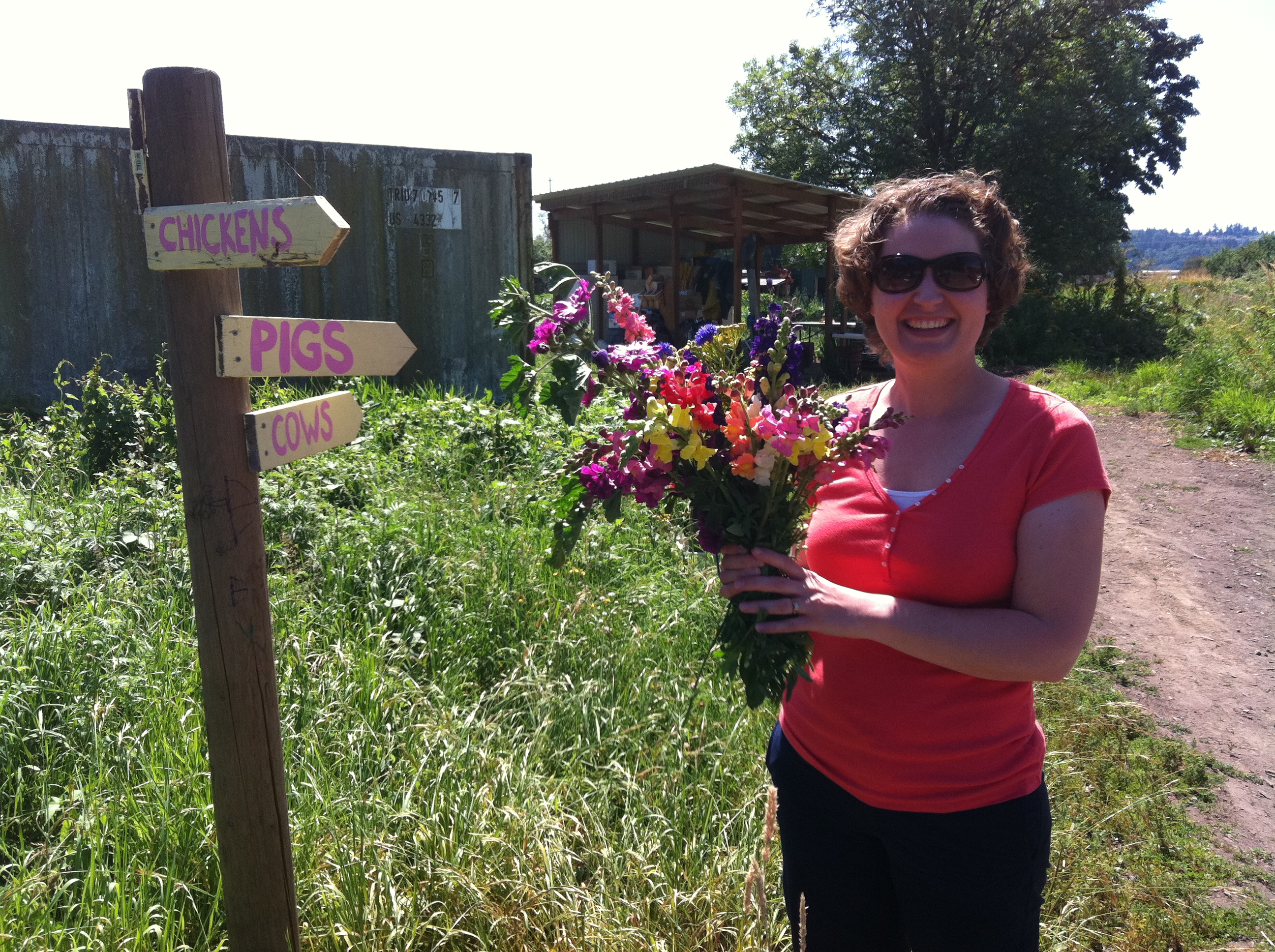
A happy customer with her beautiful bouquet from the u-cut flower garden. Nice job!

After walking a few people through the cut-flower garden today, I thought it might be a good idea to share some information on how to choose flowers for cutting.

First, here is the entrance to the cut-flower garden of 2011. Please stay on the path, and proceed to the center archway to find the individual flower rows. Please don’t pick from the pathways because I have little marigolds planted there, and you’ll actually have a better selection if move between the rows.

The most important thing to avoid are flowers that have already bloomed. It’s ok to have some instant gratification, but you really want flower buds that are JUST ABOUT TO BLOOM. You want to see color, but not a fully-open flower. Open flowers will not travel home well, they will wilt quickly, and they will not last long once they are home. However, stems still in-bud will travel well, and will greet you tomorrow morning with a cheery, perky blossom.

The next most important thing is where to cut on the plant. I see people trying to be sparing with the plant, cutting a single stem, way up high. You want to bend down and find a major joint on the stem. You can always trim them up when you get home, or even after you get all the stems collected. Not only will this give you a full bouquet, but it will make the plants produce more buds and blossoms. You are pruning the plants while you cut flowers. You will not hurt the plant, you will actually encourage it to make more stems and flowers.

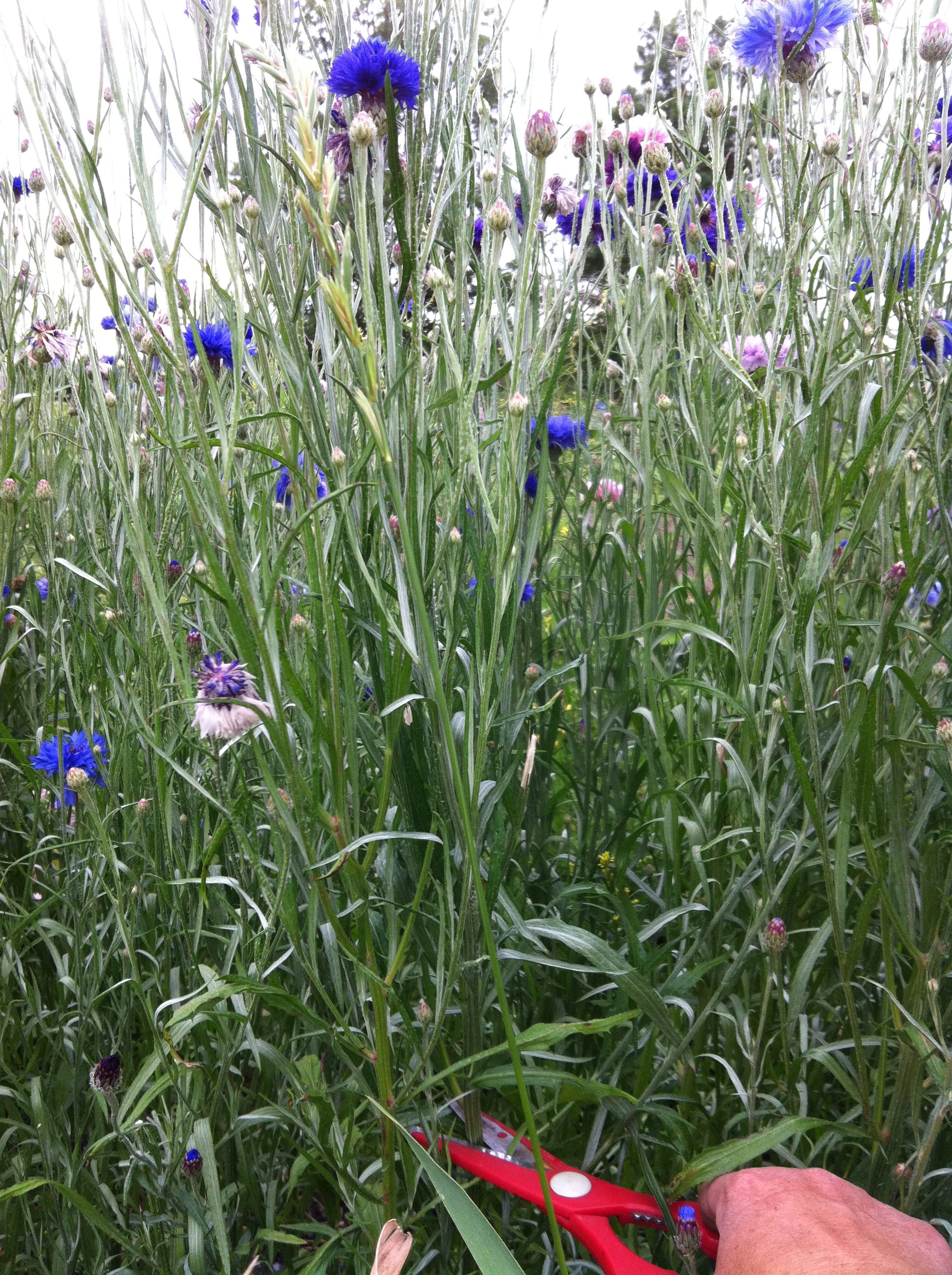
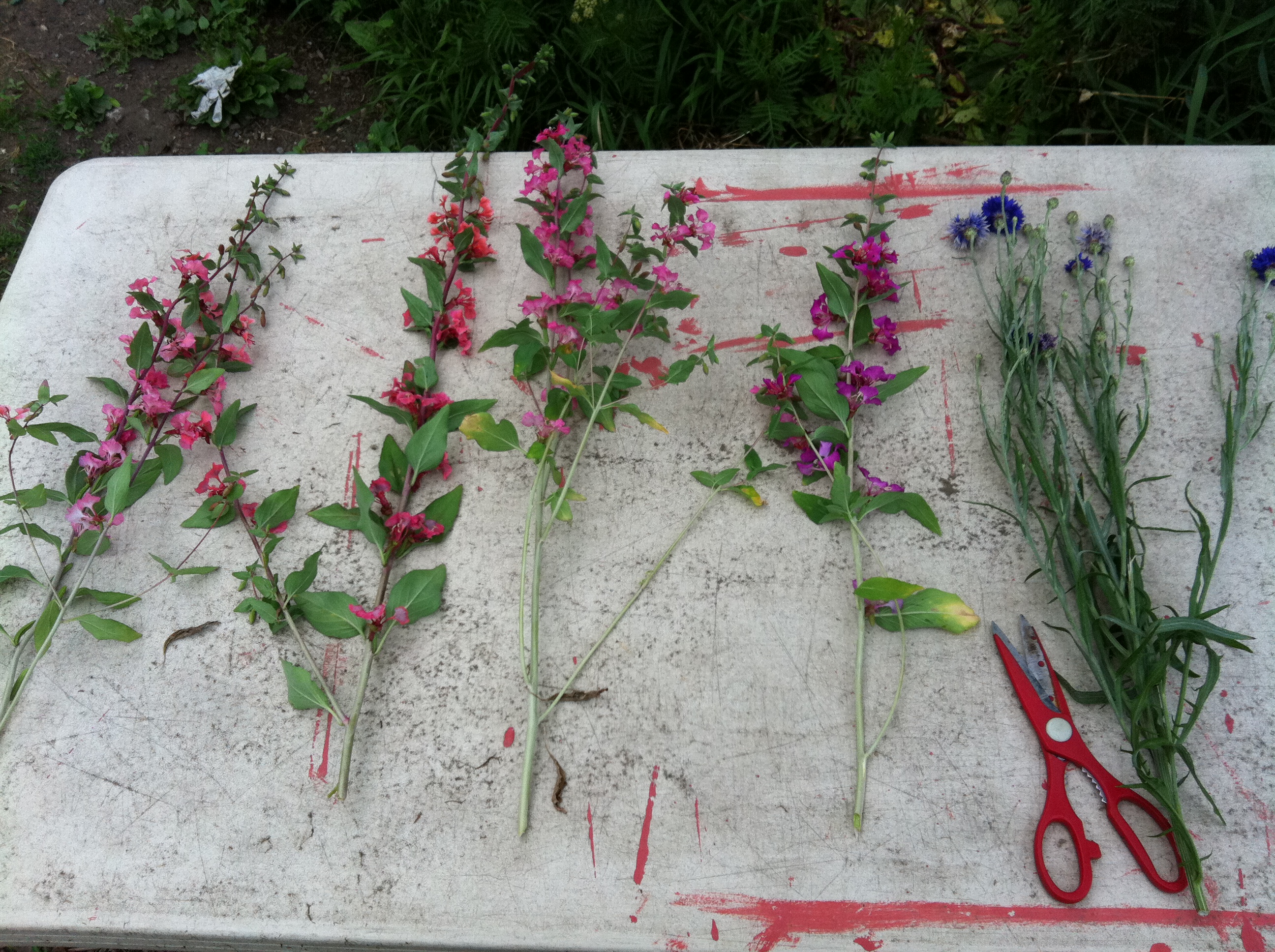
This is what you want to take home—long, stems with lots of buds and just one or two open blooms.

Once you’re finished cutting, keep the flowers cool, fill a bag with water if possible, or wrap wet paper around the stems to keep them moist. Then, when you get home, fill a vase (or jar, or glass) with warmish water and RE-CUT the stems before you put them in the water. While in transit, the ends of the stems will dry up some, and they won’t be able to suck up much water, which will make them wilt and die sooner. A fresh cut invites water into the stem.

After you get them home, you can cut the rough bunches into tidy stems so that you can arrange them thoughtfully.

Cut lots of flowers each week!

SPECIAL NOTE ABOUT POPPIES:
It’s especially important to remember not to cut poppies if they are open blooms. They must be in full bud, with just a hint of color peeking through or they will not open and last. You also need to do one more step: after you get them home, re-cut the stem and burn the end with a match, torch, or stove burner. This seals the sticky, milky sap and prevents the stem from clogging up. If you don’t burn them, they will quickly wilt and die, a sad and preventable fate.

Summer Week 4: The Battle of the Mink

THIS WEEK’S SUBSCRIBER MENU:
• Sugar Snap Peas
• Arugula
• Salad Mix
• Stir-Fry Greens
• Spinach
• Sorrel

Click on the links above for information and recipes about these crops.

COMING SOON:
Baby Turnips
Fava Beans
Summer Squash and Zucchini
Cucumbers

Great things are happening on the farm. Summer squashes are blooming, and soon there will be enough to pick for everyone. That is, more than a small basket. It takes more than that to feed 100 families, but it won’t be long. The peas are finally ready, and we’ve opened up the u-pick peas for all subscribers. Please come and take advantage of this part of your CSA share while they are in season—it’s usually not more than two or three weeks before they dry up in the July sun. We hope you’re enjoying your share so far—we’ll be bumping up the quantity very soon!

For the last few weeks we’ve noticed strange happenings in our young hen house. About once every two weeks a chicken has died—we have just been finding a dead hen in the morning. No real signs of injury, other than other chickens pecking at it. (Chickens are omnivores, not vegetarians, and will readily take part in animal protein. They’re not very discriminating, either.) We remove the body and ponder the causes. For a while it was only Auracanas (the hens that lay blue eggs)—maybe something was wrong with that batch of hens? None of the birds have been acting sick or injured.

A trail of barred chicken feathers through a planted field. There are no footprints, so apparently a hawk caught a chicken and flew over with it.

There is a Red Tailed Hawk nest next door—their nest tree across the street was cut down over the winter, so they moved to our side. We have lost a hen or two outside, and the hawks have been diving around the chickens, so it’s easy to blame them, but why wouldn’t they take the bodies? And they wouldn’t have gone in the chicken house anyway.

There are all kinds of critters that are supposed to live around here. They are on the maps, in the guidebooks. Skunks, Raccoons, Opossums, Coyotes sure—we’ve seen and/or smelled them. There are also many that are supposed to live around here that we never see—foxes, for example. Occasionally we see a weasel, and this year we’ve actually seen a few, mostly up by the big locust tree by the road. Weasels aren’t necessarily bad. They enjoy rodents, and are proficient hunters of rats because they easily fit in the rat tunnels, and they’ve never done any damage. We do have a rat problem here—between the river and the spilled grain at the feed mill down the street, it’s hard to stay on top of them. So, we’ve been hoping for a weasel family to take up residence and assume control, and they did. Haven’t seen a rat around the cow barn in months, and that IS a good thing.

But then, there are mysteries. Mike and I were doing chores Friday morning when two fuzzy black weasels crossed the driveway in front of us. They were not afraid of us, and had been visiting the big chicken yard behind the house. I tried to get a picture, but they were too quick. Then Mike yelled from the chicken house, “There’s another one coming!” So I got my camera ready, and waited for it to leave the chicken waterer and follow the other two.

I thought weasels were supposed to be rusty brown? Google on the iPhone is an amazing thing, because I soon learned that they were Mink. Yes, North American Mink are native here, before there were Mink farms. Now, it’s common to find Mink when animal rights groups release them from their cages at fur farms. This causes all kinds of havoc, for natural wildlife and for farms. They may be cute and fuzzy, but they are vicious, with few enemies. They can scare off a coyote or hawk. Michaele, at Growing Things Farm in Carnation said that there was a huge release of Mink by her old farm, and they just kept losing chickens. They never could get control of the situation until they moved to another farm. In the natural state of things, there just aren’t many, I think, or they’re not often seen. Regardless, we had a family. I was excited—no more rats! They were cute, a novelty! New wildlife!

It took us until Saturday morning to put all the pieces together. Four more dead hens Sunday morning, in the chickenhouse. Why were those old rat tunnels so clean, opening up into the chickenhouse? How long have the chickens been acting so frantic and terrorized? Hmmm. I looked up videos and more weasel/mink information. I found this, and it all became clear:

The mink had to go. (It is a weasel in the video, but a mink does the same thing, they’re just bigger.) They kill the chickens by attacking from the back and clamping their razor teeth onto the back of the head. We found not-quite-dead hens with their necks shredded, or brain-dead. Nothing could be done to rescue them. 

Monday morning there was another dead hen in the chicken yard. Tuesday morning two more. Wednesday morning, two small mink killed three chickens inside the house while Mike was standing outside. What could we do on a market day? No time to babysit chickens. I was at the Columbia City Market when Mike called me to report that he had shot the big one, and Cosmo had shot two little ones. We felt that the hens would be safe, finally.

They look cute, but we have learned a lot about Mink lately. They are ferocious killers, and they kill for sport, not just for food. It’s even worse when you have a mama teacher her three pups how to kill.

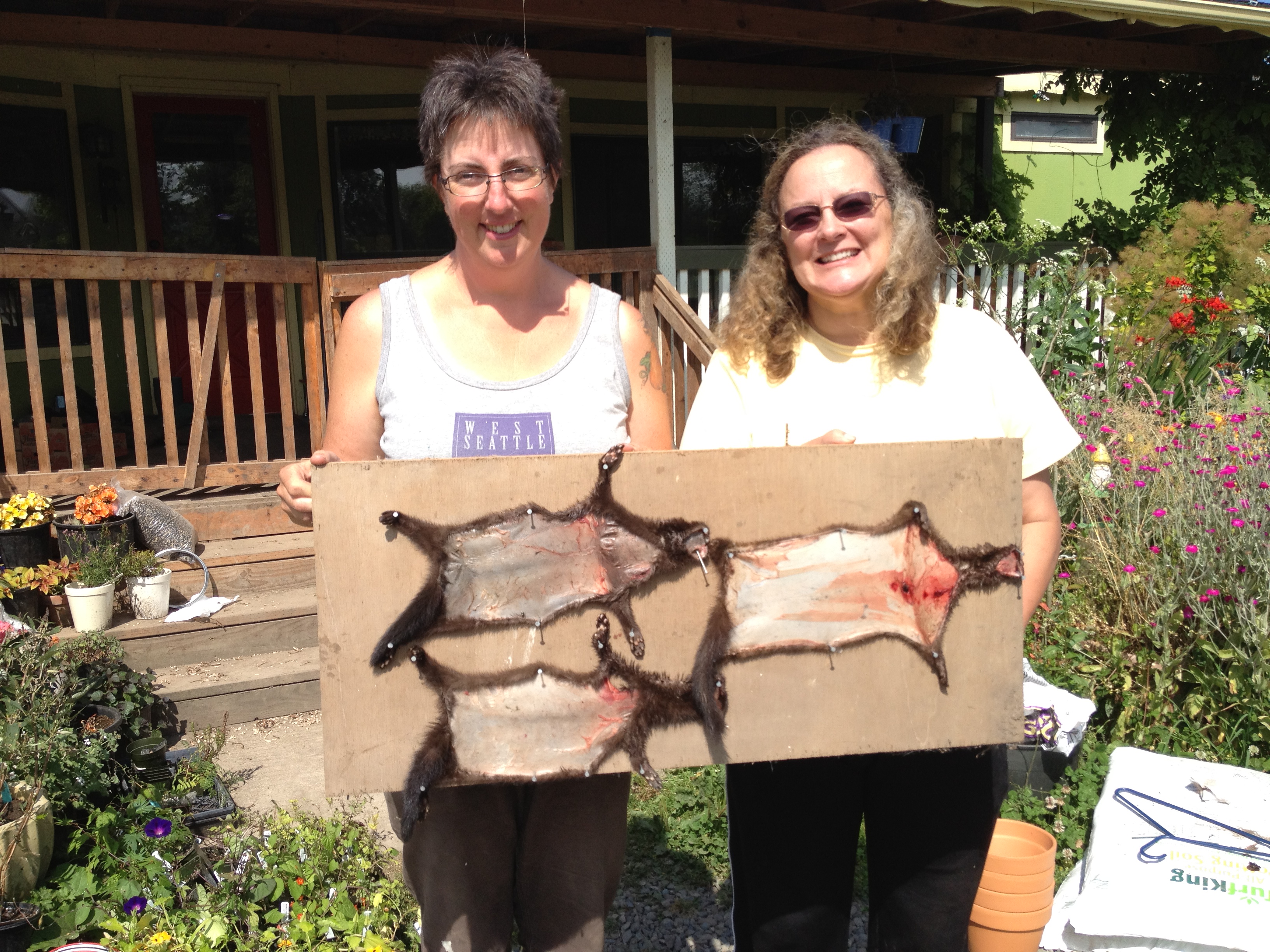
Thursday morning, no dead hens. My friend Cathy came over to learn with me how to skin them. Why waste good mink pelts, right? When I did the mama mink, I noticed three teats, not just two. There must be another one out there. Sure enough, it was sneaking into the chicken house and about to pounce on a hen when Mike got it. Hopefully that it is it.

Why let good pelts go to waste, when you can have a learning experience instead? My friend, Cathy and I learned how to skin Mink, and hopefully will successfully tan them as well.

I have always believed in the ecosystem of the farm. That means embracing the predators and pests, as well as the crops we’re growing. However, there is a line that has to be drawn. I was willing to make a sacrifice of a hen or two every couple of weeks in exchange for rat control. But four hens a day is not an acceptable loss. Soon there would be no hens, and no eggs. There is a huge investment in egg chickens—six months of nurturing before they even lay an egg. We can’t afford to lose very many.

Brazen destruction is not allowed, whether it is a massive flea beetle infestation in the arugula or a pack of coyotes traipsing through the backyard taking cats and baby chickens home for dinner. There is a balance to maintain—supporting the hawks for the short term (with an occasional chicken) means that there will be a predator base to keep the rabbit population under control next year. But there is also a tipping point to steer away from—a point of no return.

Summer Week 3: Planting

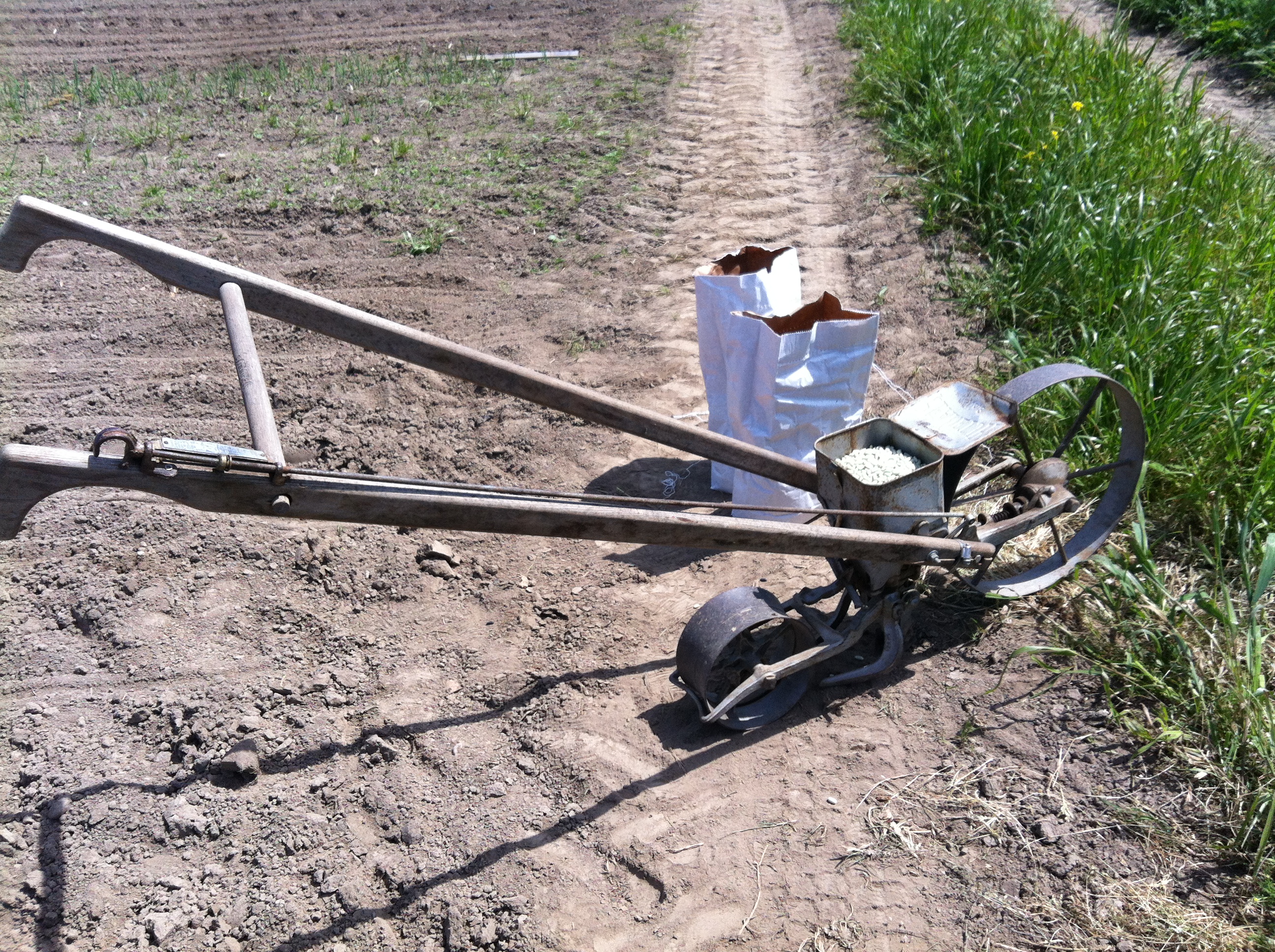
This is the spacing adjustment on the Planet Junior hand planter. The little dial spins up the threaded rod to adjust the opening at the base of the planter and let more or less seed out of the chute. I like the examples of seed sizes, from a different time, when Parsnips and Salsify were common vegetables.

THIS WEEK’S SUBSCRIBER MENU:
• Salad Mix
• Stir-Fry Greens
• Spinach
• Collard Greens or Pea Shoots or Lambsquarter
• Beet Greens or Cilantro
• Fresh Garlic

Click on the links above for information and recipes about these crops.

COMING SOON:
Shelling Peas
Sugar Snap Peas
Fava Beans
Arugula
Cucumbers

Last week was prime for planting. It was cool, but dry, with the promise of a good rain, followed by a good warm spell. We replanted the beans, pickling cucumbers, and summer squashes—something ate half of the rows, or they rotted. Hard to say which.

This is the Planet Junior hand planter that Mike’s dad used for planting their Southcenter farm. Still in operation, but the wood handles have been changed. It works great for everything except the tiniest of seeds.

I used the old Planet Junior to plant by hand certain crops—the third planting of bush beans, some more shelling beans, and parsnips and salsify for winter. The Planet Junior doesn’t have set apertures, so it lets odd-shaped and large seeds fall out easily. I also used this to get the corn planted. (Yay, corn this year!)

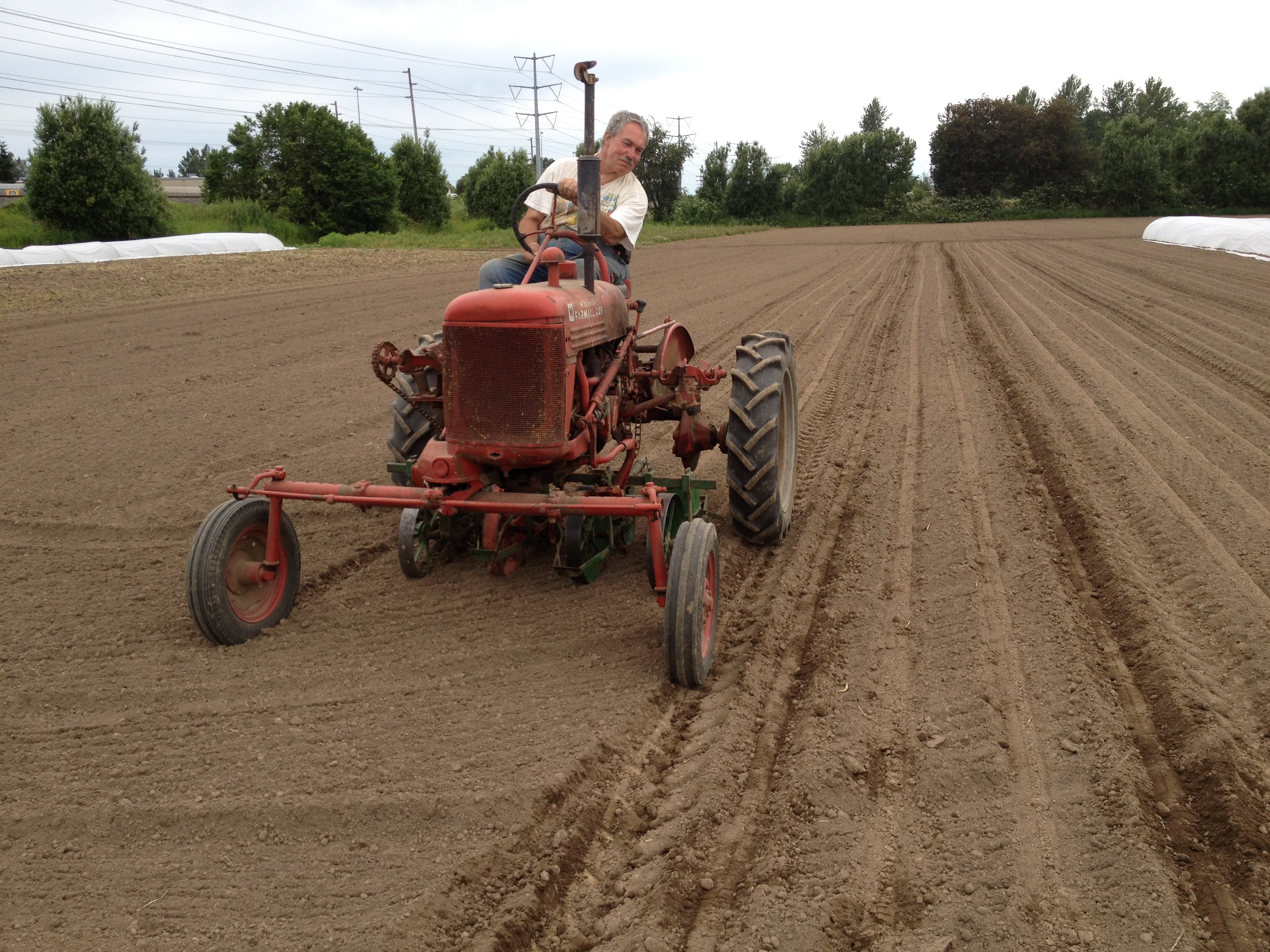
For most row crops, except large seeded things like corn, peas, squash,etc. that need lots of space, we use the 1941 Farmall Cub with belly-mounted Planet Junior planters. This way we plant four rows at a time, and calibrate the cultivator implements to the same spacing to eliminate some hand-work.

Mike used the 1941 Cub tractor with belly-mounted planters to sow the uniform seed crops—another sowing of dill, cilantro, and spinach, more beets, chard, and kale, and some kohlrabi, purslane, and odds and ends. These planters use set seed measurements so they make for even, uniform sowing.

We also finally got the winter squashes and pumpkins planted, and Mike started making beds for cauliflower, broccoli, and the BIG planting of basil.

Things are looking good for next week. The pea plants are loaded, both sugar snap and shelling peas, and we’ll be able to open the u-pick area. The new carrots, turnips, and arugula are looking great, and the cucumbers are blooming like crazy. Even the tomatoes are kicking into gear finally. Summer is finally on the way!

Summer Week 2: Summer Rain

The first cucumber blossoms are setting fruits in the greenhouse. I’m predicting the first slicing cucumbers for everyone in three weeks.

THIS WEEK’S SUBSCRIBER MENU:
• Salad Mix
• Green Onions
• Spinach
• Carrots
• Beet Greens or Pea Shoots
• Fresh Dill

Click on the links above for information and recipes about these crops.

COMING SOON:
Shelling Peas
Sugar Snap Peas
Garlic
Fava Beans
Arugula
Cucumbers

Last night for dinner, I sliced a bunch of carrots into coins, and sautéed them in a bit of butter, finished off with a bunch of chopped dill. We had salad with it, and grilled pork chop. Someone commented today as she picked up her produce that her basket looked like quiche—spinach, dill, and green onions, and a carton of eggs. Early summer is delicious.

Alternating rain and sun spells are perfect, but we really need a small warm stretch to get things growing faster, and to kill some weeds. Weedy crops don’t grow as well or produce as much as they do when somewhat clean.

Rainy days in June are for doing inside work. Tomato greenhouse is ready for growing, with trellises up and weed-block fabric down. Tomatoes will be easy to see and pick this year.

The Friday downpour was the perfect opportunity to make up for lost time in the greenhouses. Both the tomatoes and cucumbers were in dire need of attention. We like to grow them both upwards, on supports (or trellises) so that the plants stay clean and tidy, which helps prevent disease and makes the fruits easy to find and harvest. In one day, we got all the posts put in, netting hung, and weed-block fabric stapled down to the ground. It’s all easy from now on, no weeds to battle, and just training the plants up the support. And reaping the harvest—cucumbers in about three weeks, tomatoes in about five weeks.

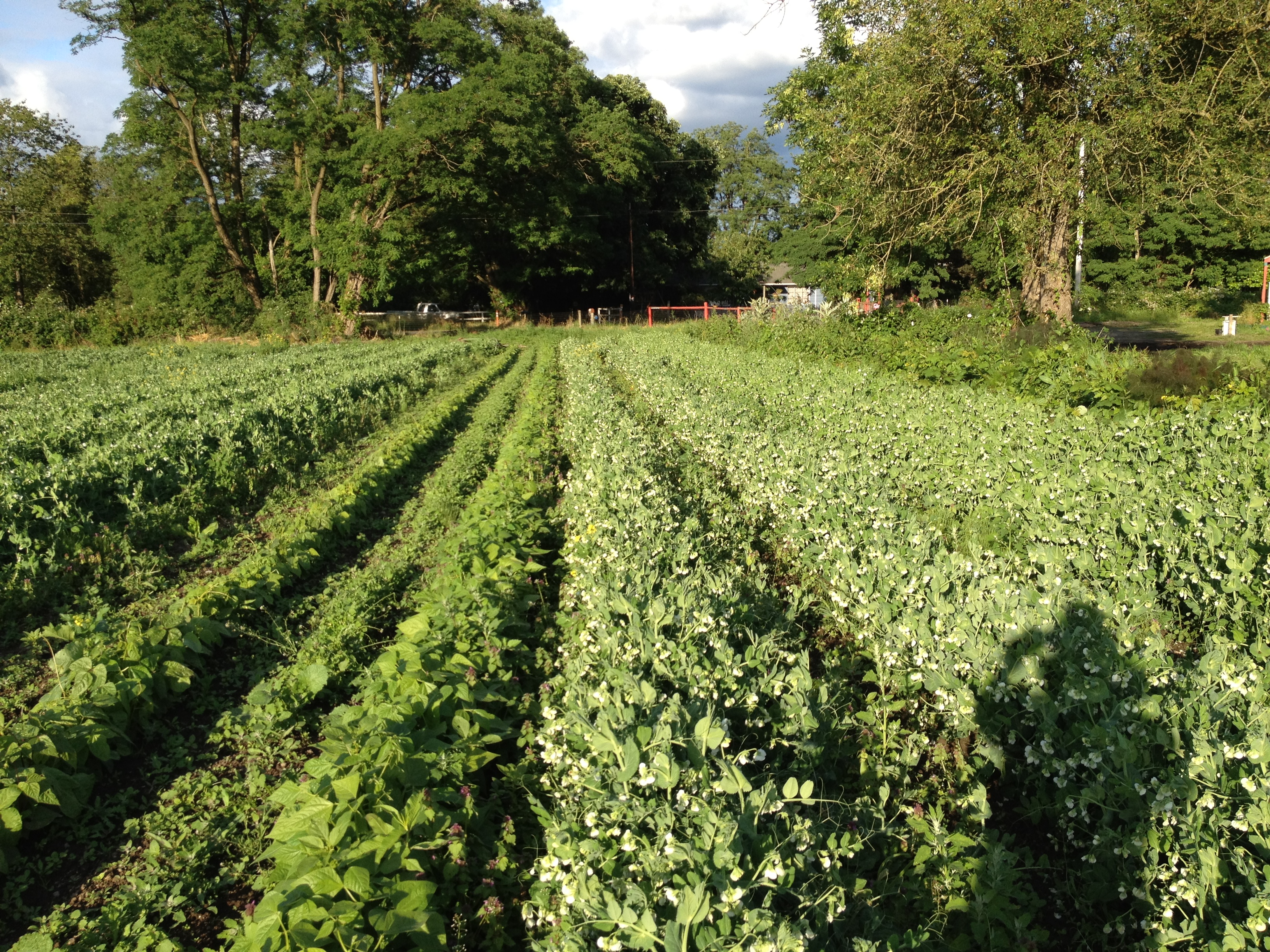
The u-pick area for subscribers is nearly ready. Look at all those pea blossoms! They are going to be covered with pods soon, and that means easy picking!

The peas are setting pods—luckily they don’t care much if it’s cold. Some plants won’t set fruit if the temperatures are too low, but peas don’t care. The pea patches are loaded with blossoms, and that means easy picking with lots of juicy pods to pick in just another week or two.

It’s just warm enough to have the windows open in the house tonight, so I can hear the chirping of the Killdeers as they swoop past the house, I caught the shadow of a Barn Owl as it dipped past the office window, and the chorus of frogs outside is deafening. Hoping for a warm, sunny day to catch up on planting tomorrow.

Summer Week 1: Solstice Day

Teo got the new carrot, turnip, and arugula patch covered with rowcover fabric to keep out the flea beetles (which eat leaves) and root maggots (which tunnel into roots). We should have a nice, tidy crop in a few weeks.

THIS WEEK’S SUBSCRIBER MENU:
• Sugar Snap Peas (eat the whole thing!)
Fava Beans
• Salad Mix
• Beet Greens
Pea Shoots
• Cilantro

Click on the links above for information and recipes about these crops.

COMING SOON:
Spinach
Dill
Shelling Peas

I really intended to get the first post of summer done on the first pick up day, but it wasn’t meant to be. Maybe I should say, “bee”, because when Mike and I returned from doing the Seattle deliveries, I found another swarm hanging by the greenhouse. This time was like having the second child—I was much more relaxed about the situation. I waited for a while, packed up eggs, did some chores, chatted with people while they picked up their veggies. After a while, I suited up and went to check out all the hives, since it was a nice, sunny afternoon. I combined the two partial hives that I split a couple weeks ago, since they seemed to weak, and one appeared to have a new queen. Checked on the others, which were building new queens. And then, worked on the swarm. This time, I used the tricks I learned after I lost the swarm two weeks ago, and they stayed in the box I caught them in. I got the stragglers at dusk. Only got stung twice. Here’s the new configuration. I’m still hoping for some honey this summer.

Tuesday afternoon one of the hives swarmed again, and I’m not sure which it was. I successfully caught them this time—in the box on the left. There are baby queens nearly ready to hatch in each hive, which is a better situation than the last time I checked, when there didn’t appear to be queens anywhere.

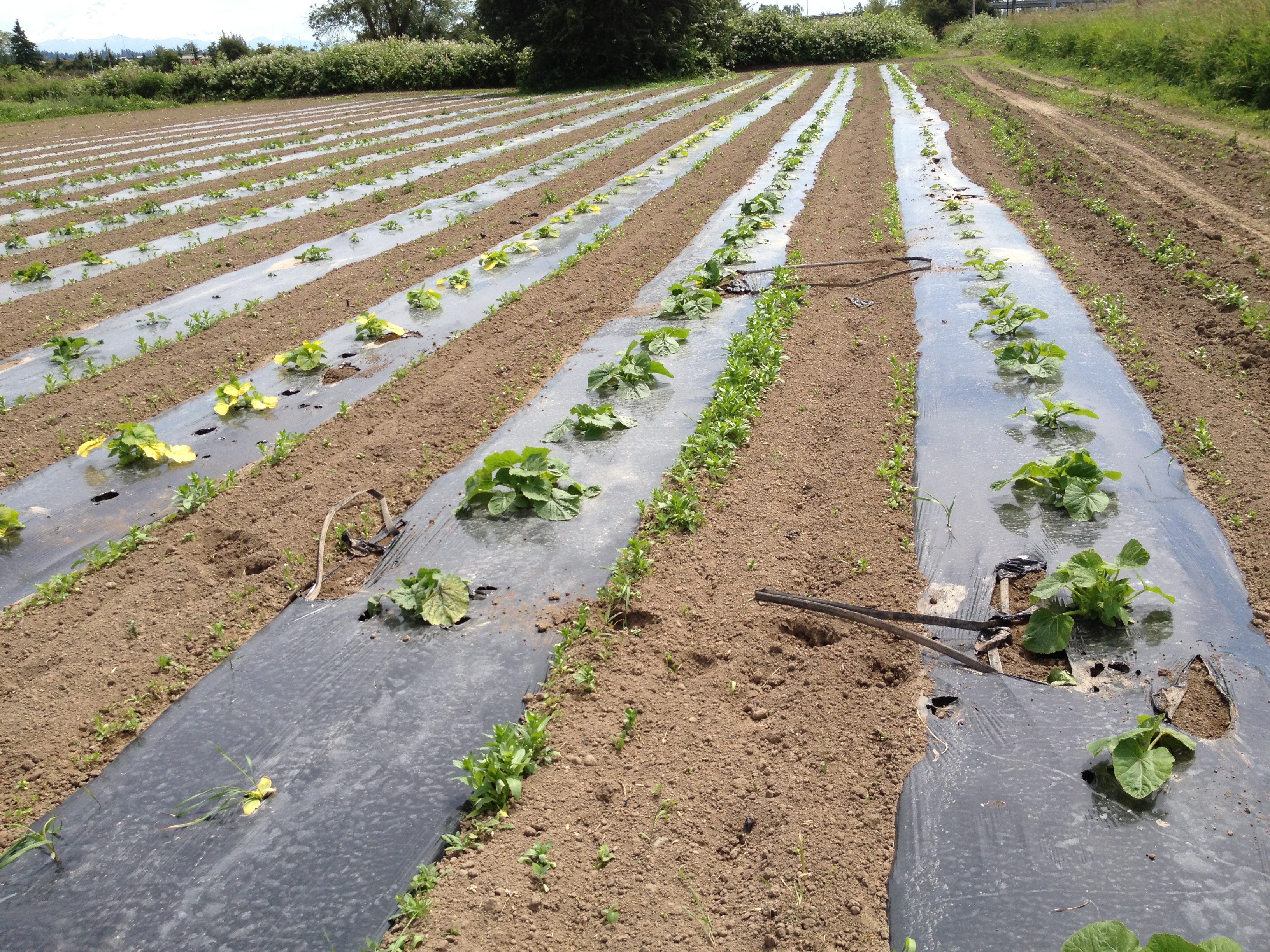
After all the sweaty bee work (it’s hot in that bee suit) we took Cosmo up the hill to cross over to Bear Cub Scout. We were socializing when Teo texted me, “Shelley the big pig is out”. That was an abrupt end to the festivities. We got home to find that Henry had tipped over the garbage cans and went walkabout. The ladies who raised him told us that his favorite food was Spaghetti, so I grabbed a jar of sauce from the pantry and headed out to lure him home. It worked, and he didn’t do massive destruction, but all a 500# pig has to do is wander through things to tear them up. The worst part was in our summer squash and cucumber patch, where he enjoyed pulling up our irrigation tape and walking on plastic mulch. Miraculously, he didn’t eat any plants.

Our boar, Henry, decided to break out of his pen by shorting-out his electric wire and he went for a leisurely stroll around the farm before we could round him up. He spared most of the summer squash and cucumbers, just played with the drip irrigation tape and enjoyed the feel of plastic under his feet.

 I’d like to take a moment to welcome all of our new subscribers. You can find recipes on the right sidebar. You can also find links to those pages by clicking on the menu items above. Please email me if you have any questions about how to eat things.

Summer Solstice is one of those magical days—the longest day and shortest night of the year. It’s perfect when it’s a sunny day, and it doesn’t get dark until almost 10:00. It’s even more perfect when it falls on the last day of school and we don’t have to get the kids in bed.

Spring Week 10: Spring Treat

Green Candy. We’ve only had Sugar Snap Peas this early once in our 15 years, and we’ll have them for a while—this is only our first planting. Enjoy!

THIS WEEK’S SUBSCRIBER MENU:
• Sugar Snap Peas
• Stir-Fry Greens
Beet Greens
• Spring Mix with Nasturtium Flowers
• Green Onions
• Baby Turnips

Click on the links above for information and recipes about these crops.

COMING SOON:
Spinach
Cilantro
Dill
Shelling Peas
Fava Beans

Well, the rumors were true. For the second occasion in our history, we have Sugar Snap Peas ready during our Spring Season. They will be sweeter next week, after some temperatures above 70°—there are LOTS still coming on those plants. You can steam or sauté them if you wish, but we end up eating them fresh.
I’ve had a lot of questions about the turnips. Some folks think they’re radishes, because the leaves are kind of radishy, but they are a special type of turnip, originally from Japan. There are several varieties now, but they’re referred to as “Tokyo Market”, or “Hakurei”, among other names. They are special because they are sweeter and more tender than typical purple-top turnips. They also have a slightly fruity flavor. Eat them raw in place of radishes, or steam, grill, or gently sauté them. They don’t need much cooking like a big, coarse, winter turnip.
We’ve got Cilantro, Dill, and Basil on the way. The spring mix is coming along steadily, so hopefully we’ll have it until the full-sized lettuces come along in a few weeks. The new spinach patch is coming. The new carrots are taking longer than we like, but they’ll be along in time.
Here’s a hint that summer is nearly here:

The wild blackberries are starting to bloom. This is where our serious nectar flow for honey lies. Also several weeks earlier than last year.

Blackberries are blooming! They’re coming on about a month earlier than last year. The bees know it—one of my hives swarmed on Monday, and it’s killing me that it hasn’t been warm enough to go in and check all the hives out and make sure they’re content. I sure don’t want to lose any now that the real nectar flow is about to come on.
This is the busiest time for us, so I apologize if I don’t get back to you right away. And I will be SO glad when school is finally out and we can switch to our summer routine!

Spring Week 9: Busy Bees

THIS WEEK’S SUBSCRIBER MENU:
• Beet Greens
• Spring Mix with Nasturtium Flowers
• Pea Shoots
• Green Onions
• Arugula
• Yokatta-Na

Click on the links above for information and recipes about these crops.

COMING SOON:
Sugar Snap Peas
Garlic Scapes

I have always had an obsessive personality. Even as a kid I would focus on something, completely absorbed, and get angry when I had to stop for dinner. My dad called it “persistence”. He admired the stubborn-ness, maybe because he had it too. I admire it in my kids, even though it makes me crazy. What can I say, passion is powerful stuff. So, it’s no wonder that now that I’ve discovered bees, I am fascinated, drawn-in, and they consume most of my thoughts these days. I’m sorry if many aren’t interested. But this is my soapbox, and I will try not to bore anyone.

As soon as the rain clears up these bees are out the door, ready to bring home the goods. If you try to stay below the entrance, not as many bees run into you.

I try not to bother the bees too much, even though I would love to open up the boxes every day and observe. I managed to stay away for three weeks after Cosmo and I picked up the new colonies. Two weeks spanned before I checked last Friday and I was astonished at what I found. They were both getting ready to swarm! Swarming is not a bad thing for bees, it’s only really bad for humans keeping bees. When things are going so well in the colony that the bees run out of space for babies and food, the workers start plotting the mutiny-of-sorts. They start building queens—this is not the queen’s job, she just lays eggs, and the workers decide whether they should be workers, or drones, or queens. What happens in swarming is that as the baby queens mature, but before they hatch, the queen leaves in a ball of bee glee—roughly half of the colony will gorge themselves on honey and leave the hive and go in search of a new home. They leave behind the remaining food (honey and pollen to feed babies), half of the workers, and incubating queens. If multiple queens survive to hatching, they duke it out in a sting-fest and the strongest one becomes the ruling egg-layer.

An interesting fact: A swarm is actually the safest time to get up close and personal with bees. They are as happy as bees get—stuffed with honey (and therefore unable to sting) and ready to settle down. So, that said, if you ever find a swarm hanging in a tree or on a bush, please call me immediately and I will come and get it. I’ve seen two in my life and they really are amazing to see.

Seven queen cells and a chunk of drone brood removed from a hive.

But, as a budding beekeeper, I did not want half of my bees to disappear and leave my remaining colonies potentially weaker. Fine for them, but half as many bees only make half as much honey. So, I did an experiment of sorts. I divided Hive #1 into two. This is called a “split”. I took three frames of brood (baby bees and eggs, covered with workers), with two queen cells attached and put them into a new empty box. I left the old queen and all the remaining brood and bees in the old box. So far so good, no swarm yet, but they need to be coddled. There aren’t as many bees to take care of the brood, or keep them warm, so they need to be fed well and left alone. Then, in Hive #2 I rearranged the frames to create more open space (to convince the bees that it was not crowded), and I put a honey super (another box) on top so they had plenty of room to expand. I also removed all the 8 queen cells that were installed. They look like peanuts. Hopefully that will do the trick, and all the bees will stay around to make blackberry flower honey. My fingers are all crossed.
The blackberries are loaded with buds and ready to pop as soon as the weather warms again. The peas are loaded with pods and waiting to sweeten up with some warmth as well. They’re just not quite sweet enough yet—believe me, I’ve been testing them plenty. We’ve got the first plantings of basil, cabbage, fennel, and much more. Next week is a big one for planting—thousands of broccoli, cauliflower, more basil, thyme, parsley, and more lettuce varieties.
The dahlias have popped up in the cutflower garden, and we’ll be putting in the final planting this week, including the zinnias and sunflowers. Summer is around the corner!