Category Archives: Uncategorized

Spring Week 8: Promises

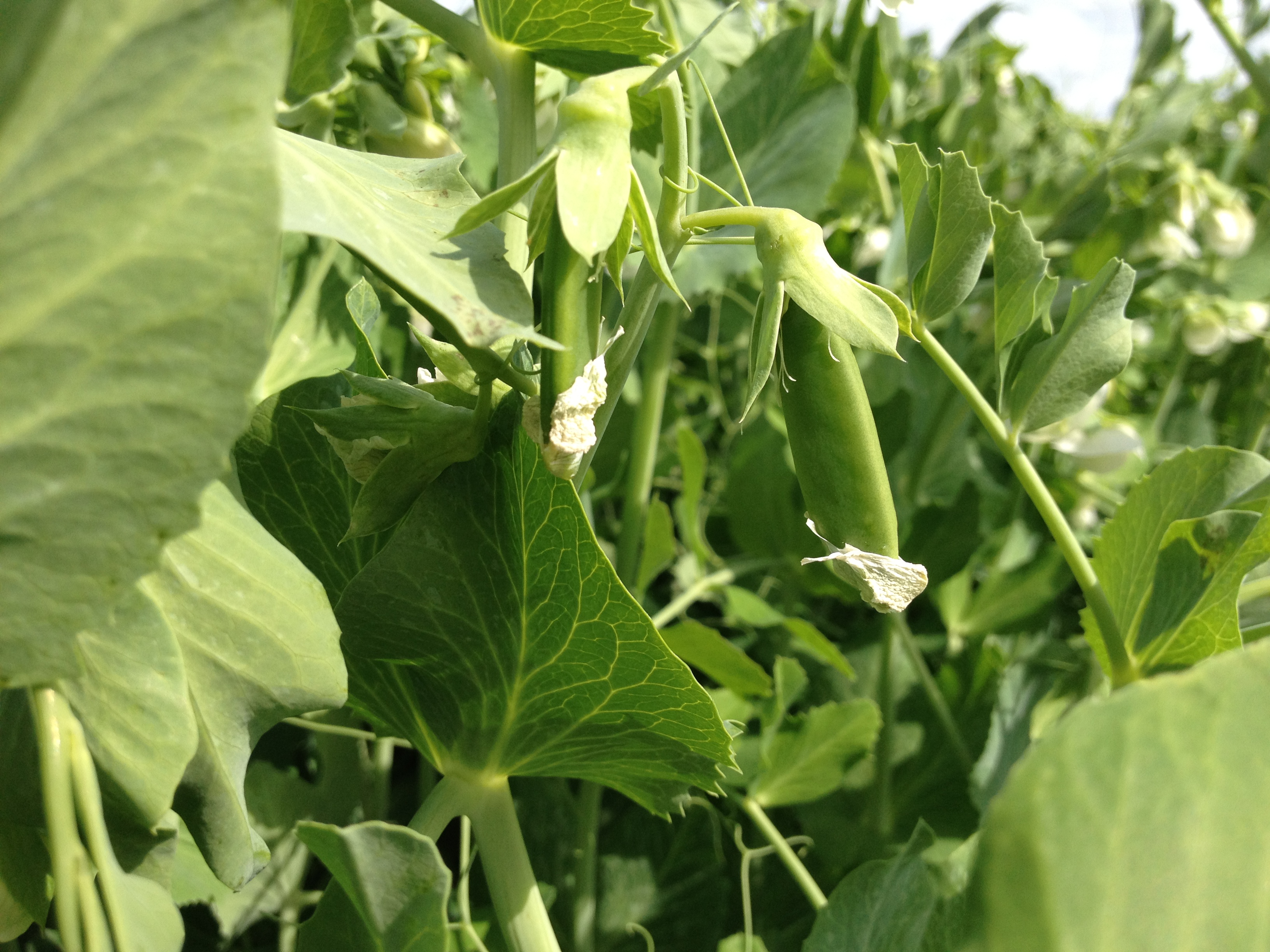
The promise of peas. Won’t be long now.

THIS WEEK’S SUBSCRIBER MENU:
• Carrots
• “Plum Purple” or “White Icicle” Radishes
• Pea Shoots
• Broccoli Raab
• Spinach
• Yokatta-Na

Click on the links above for information and recipes about these crops.

COMING SOON:
Arugula
Spring Mix
Peas

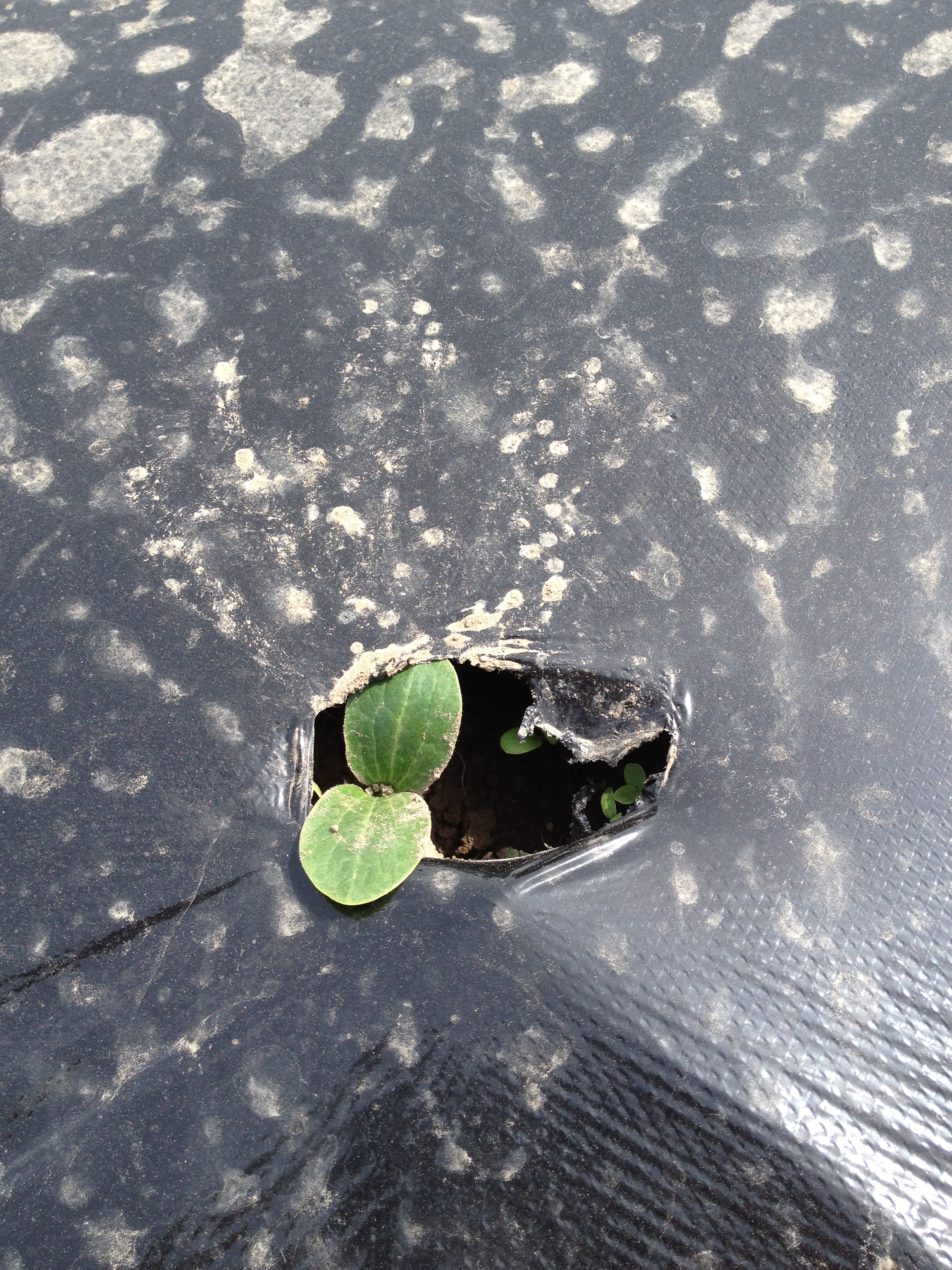
Tiny summer squash seedlings are starting to peek out of their plastic-warmed beds.

The season is coming along. We got a nice swath of beds made, so all the summer squash are planted, we’ve got a nice big patch of pickling cucumbers planted, and the pole shelling and romano beans. It’s been just warm enough in 6 days to get them all popping up out of the ground. The first, early peas we planted back in March are blooming and setting pods, and the second planting is strong and healthy. Bush beans are growing their first leaves. Teo got all the bazillion onion transplants in the ground, and he can at least sleep easy. That was a two-week long project. The sweet potatoes arrived and are now planted.

Rainy days are for greenhouse work. The cucumbers are set into cozy beds inside, ready for their trellises to be installed. The tomatoes will go in next. We had actually planned on having the tomatoes planted several weeks ago, because usually it’s too cold and wet to do much outside. However, the weather has been pretty decent this month, so we’re just now getting to that project. We should have a good crop this year though, don’t fret.

We’re actually going to give sweet corn a try again. We haven’t bothered for the last two years—not much point if you can’t plant until the end of June. But, we’ll be planting next week, sweet Bodacious ears are already calling. Winter squash will go in next week as well. So will the first big broccoli and cauliflower plantings.

Several people have asked about fruit. We have decided to partner with Tonnemaker Orchards in Royal City. They already offer a Fruit CSA, and have provided an application form for us. You can download it here: Fruit CSA Brochure  Please email me or Stacy (her email is on the form) if you have any questions, and make payments to Tonnemakers. You will be able to pick up your fruit on your Tuesday or Saturday pickup here at the farm.

Spring Week 7: Chicks and Carrots

The first carrots of 2012.

THIS WEEK’S SUBSCRIBER MENU:
• Carrots
• “Plum Purple” Radishes
• “White Icicle” Radishes
• Pea Shoots
• Green Garlic
• Sorrel

Click on the links above for information and recipes about these crops.

COMING SOON:
Spinach
Arugula
Spring Mix
Peas

Few vegetables elicit squeals of joy like a sweet, tender spring carrot. Maybe a warm, ripe tomato would do it. Or the crunch of a fat, sugar snap pea. But carrots are always welcome. We planted these early babies in the big greenhouse in March. They’ve been slowly plugging along for over two months, and finally, they’re ready to pluck from the ground. They’ll be a little bigger next week, so don’t fret.

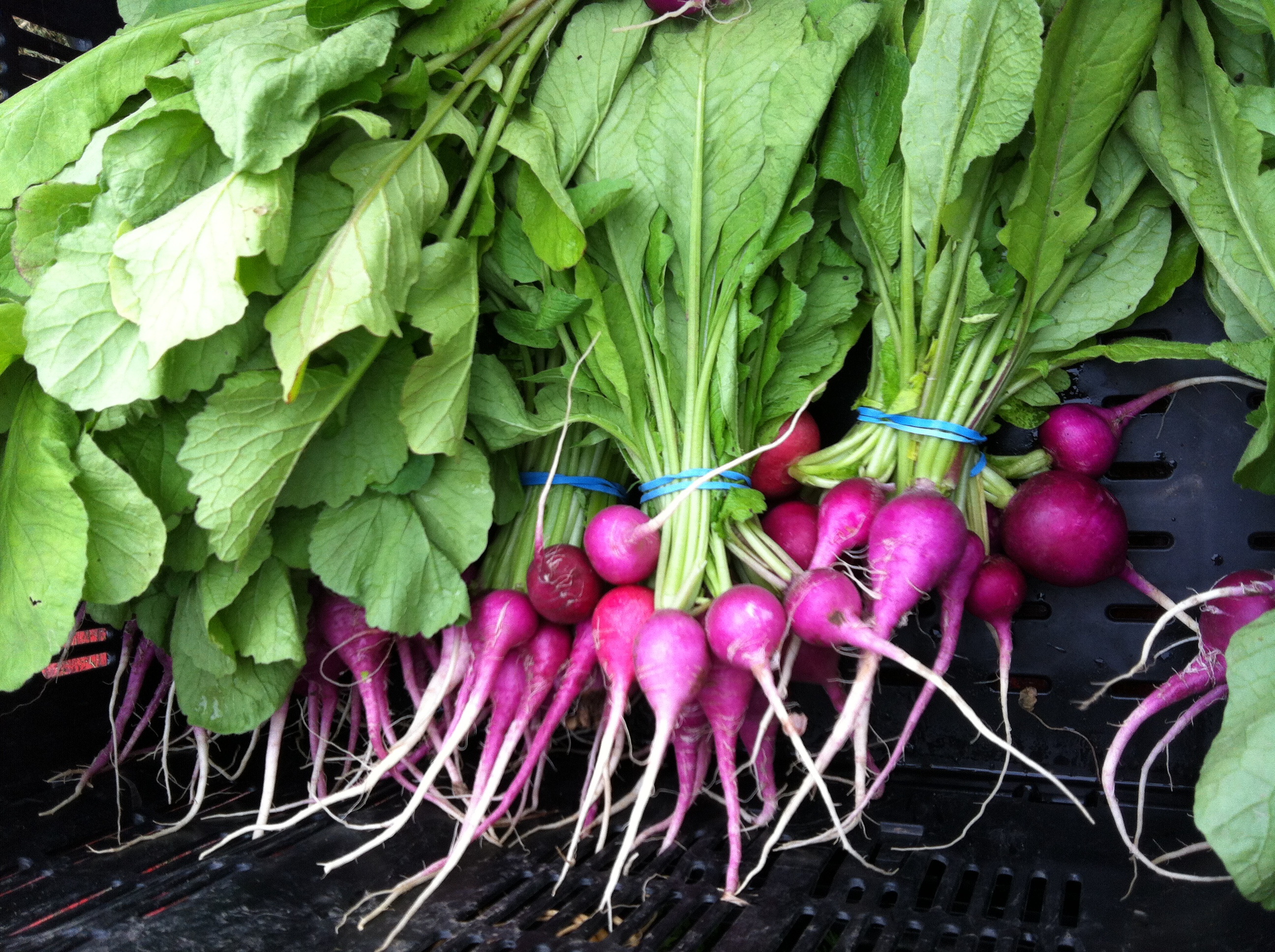
Any radishes are welcome in the spring, but you can’t beat the violet hue of “Plum Purple”.

Radishes are in their prime this week, which is good, because there isn’t much else outside that is ready to pick yet. However, the spinach, arugula, and peas are coming along and will be ready soon. We had an early opportunity in April for planting, and we got as many radishes and turnips as we could in the ground, and got them covered to protect them from nasties like Cabbage Root Maggot. Nobody likes those in their roots. This week the Plum Purples and White Icicles are ready, and both are a good match with another bunch of pea shoots and sorrel.

Finally found this hen, after finding a baby on the ground. I had looked for two days and finally heard more peeping on top of the ceiling of the cow barn. There’s an overhang there, and she was quite cozy on top of the fluffy insulation.

On a side note, yesterday in the downpour I heard loud peeping coming from the pig barn area. I put my boots on and went out to look for the source and found a recently-hatched soggy chick. No mom or siblings anywhere, so I brought it in the house in my pocket to warm up. I went back out several times to try and find its family, to no avail. She was doing a good job of hiding. Finally tonight, while feeding the cows, I heard more peeping. Then I remembered seeing a black hen looking down from the roof one day, a while back. I got the ladder and climbed up—sure enough, there was a black hen with a handful of new chicks.

Cosmo ran to the house for me and got the chick, and I put it up there with the others. But it kept returning to me! This was not the time for bonding! A new chick can only stay in a shoebox on the stove for so long! I gently shoved the chick to the bristly hen with a broom and then ducked away. Fed the cows, and checked-in and it had disappeared under all the fluffy warmth with its siblings. Tomorrow, we will have to get them all down safely before they fall to their death and get eaten by pigs. Never a dull moment.

Spring Week 6: Marketing

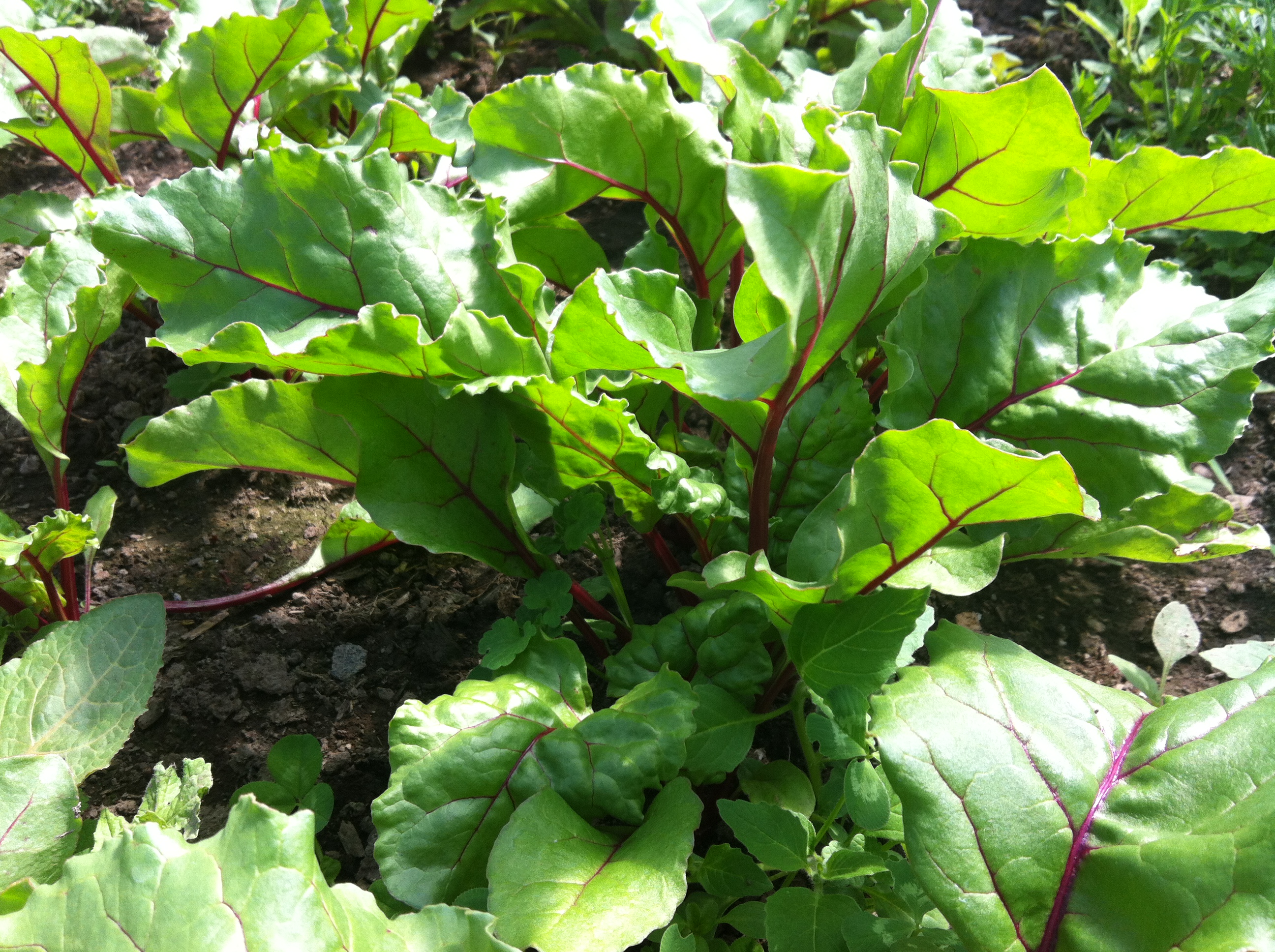
The first beet crop we plant in the new season are for greens. We may eventually get a beet, but this first spring crop is for those tender leaves. Slighly beety, nutritious, and NOT KALE.

THIS WEEK’S SUBSCRIBER MENU:
• Beet Greens
• “Prom Queen” Radishes
• Stir-Fry/Salad Greens
• Green Shallots
• Pea Shoots

Click on the links above for information and recipes about these crops.

COMING SOON:
Carrots
Arugula
Spring Mix
Peas

Mothers’ Day is always on a Sunday, and so is the West Seattle Farmers Market. Many folks think I should have the day “off”, but I’m not really sure what that means. Home, with all the cleaning and planting? No—I love my job, and I love going to market. Seeing all the other mothers on a beautiful sunny day is fun.

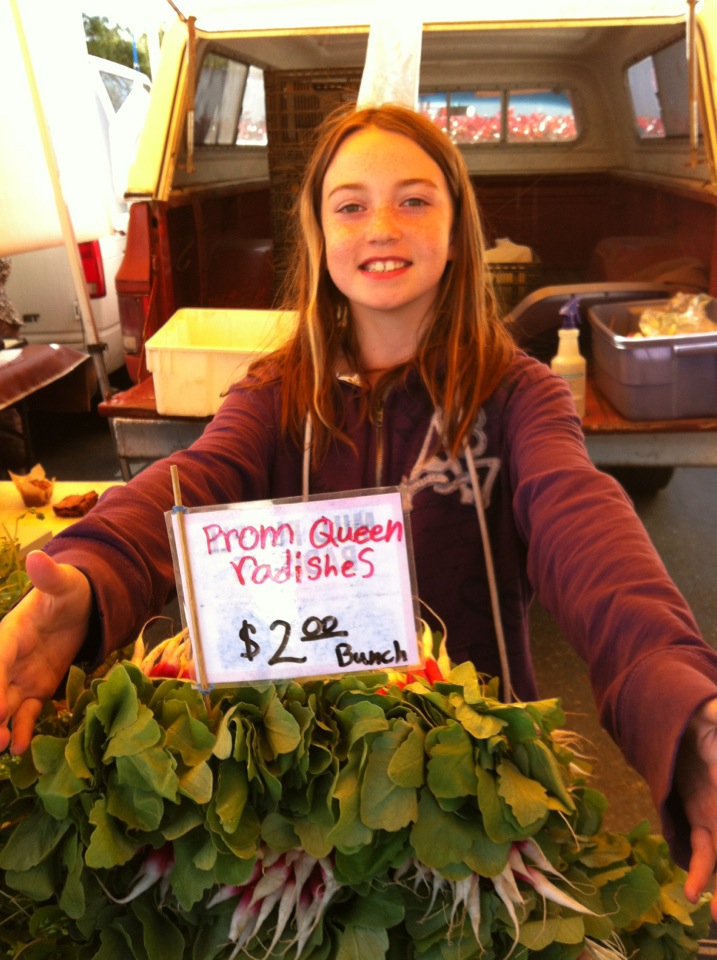
Della’s first experiment in marketing.

Della likes to go to market with me. This week, we have our big outdoor crop of radishes coming on. We picked some of the French Breakfast type, even though they were tiny, because they were just so pretty. Della and I were setting up the table, she picked up a bunch and announced that they looked like girls in prom dresses. Since we couldn’t find a sign for them (the sign box needs a makeover), she made a new sign. I said she could call them whatever she wanted. Now everyone knows these special radishes as “Prom Queen”, but you will never find them in a seed catalog with that name. I can’t wait to see what she names the White Icicle and Plum Purple radishes.

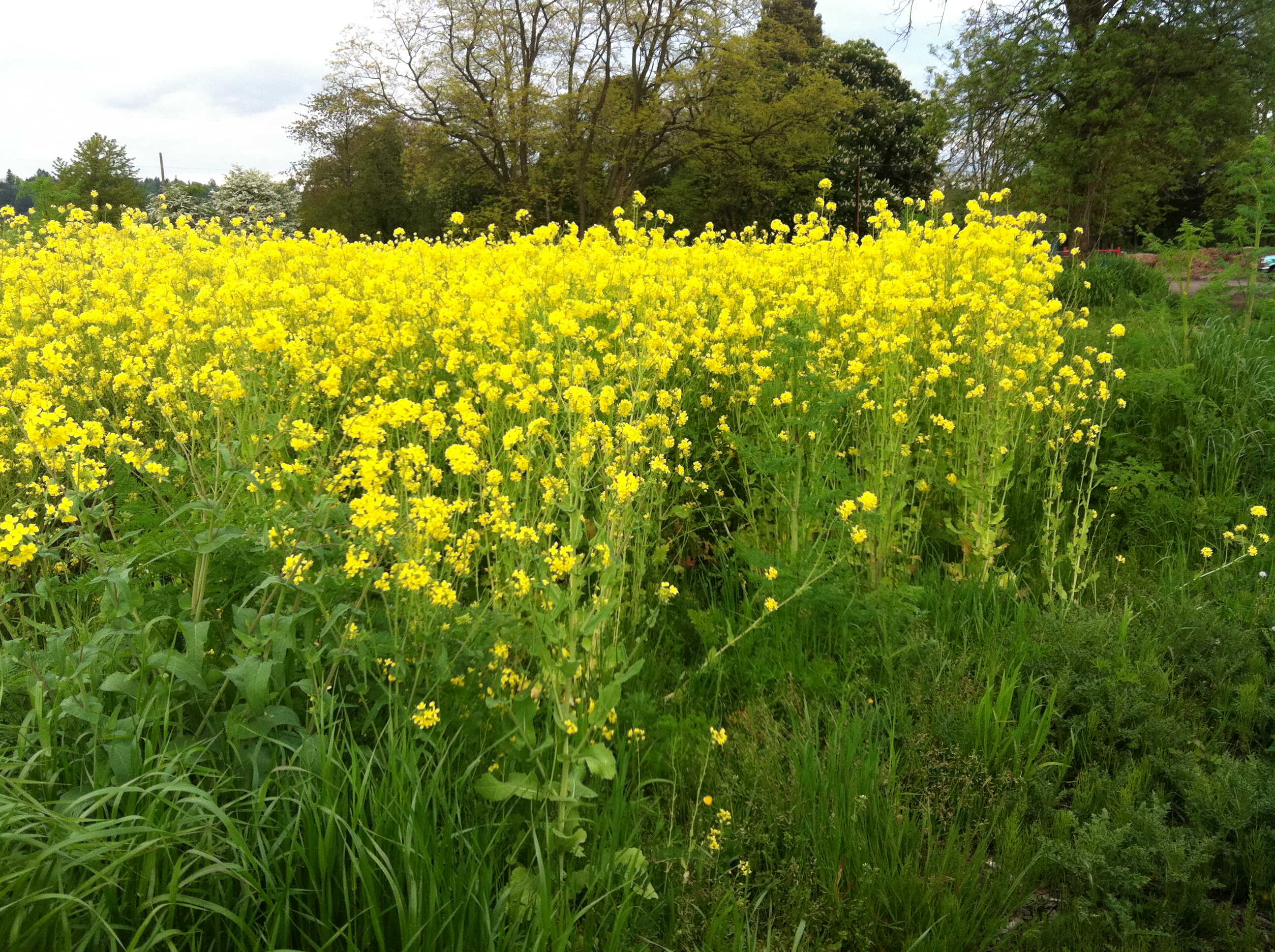
The overwintered crops are nearly done-for. Kale and Turnips are all a-flower, and now that Hawthorn trees are in full bloom, we can safely cut the mustard and not leave the honeybees (and other pollinators) without a source of nectar and pollen. The spring-planted crops are nearly here—beet greens, pea shoots, and radishes are plentiful, and arugula, spring mix, spinach, and carrots are not far off.

Eat those tender beet greens with the little beets on. Just a quick sauté or steam and you’re set. Many people prefer to them to Swiss Chard which just seems coarse compared to these dainties. I count myself in that camp.

Spring Week 5: Crows

The rapini is gone for the year. Warm weather is good for many things, but it makes the brassicas flower like crazy.

THIS WEEK’S SUBSCRIBER MENU:
• Claytonia or Rapini
• Radish Greens
• Purple Sprouting Broccoli
• Swiss Chard
• Green Garlic
• Sorrel or Parsley

Click on the links above for information and recipes about these crops.

COMING SOON:
Baby Beet Greens
Carrots
Arugula

The reason we don’t advertise our Spring Season, or accept many families into our Spring Season is because it is fickle. Sometimes it is even a volatile season. The first four weeks of Spring have been amazing this year. Abundant, varied, and tasty. As much as we all love and appreciate the warm, sunny weather, that same weather encourages the overwintered plants to burst suddenly into flower. That means the rapini is a field of beautiful yellow blooms—the bees are loving that field, and are bringing basketloads of honey back to the hives to feed their brood. Unfortunately, that means we’ve reached the hump, or rather, the valley of spring. The overwintered crops are petering-out, and the spring-planted crops are not-quite-ready.

BTW, Radish Greens are pretty tasty. I found them mild and tender enough to chop and use as salad—kind of like arugula. You can also cook them like turnip or mustard greens. We don’t know why the greens got so big, but at least they taste good.

So, for the upcoming beautiful sunny weather forecast, we will have a corresponding low produce forecast. There is not as much to harvest this week, and probably not next week either. However, the outlook is good afterwards.

Usually, these weeks of increasing daylength are when we experience our annual overabundance of eggs. And, until last weekend, the hens were outdoing themselves—60+ eggs each day from only 90 hens. More than respectable production. But suddenly, around last Friday, they dropped to only 35 or so eggs per day. It took some investigation, and observation to finally figure out the problem.

Crows.

Crows are a remarkable species. In my mind, they rank with rats, starlings, and possibly cockroaches. Adaptable, intelligent, inventive, and destructive. We’ve had plenty of experience with this species that seems to have very few predators. The seem to constantly increase in population. They eat anything, and find fun in everything—one of their favorite games seems to be plucking newly-planted garlic cloves out of the ground in the fall, so that they all have to be re-planted. Solve that by covering the beds of garlic with fabric. I painstakingly put plant-name markers in every planting, so that I can evaluate different varieties of each crop. They love to pull out the tags and strew them around the field, and it doesn’t matter how deep I stick them in the ground—they dig them out just to peeve me. And, they love eggs. They have figured out how to get into an exposed egg carton and dig the eggs out. They have figured out how to get inside a box covering the egg cartons and dig the eggs out. Now, they have decided that it is cool to go inside the chicken-house and get into the nests on the back side of the house and steal the eggs. The chickens don’t seem to care. We have temporarily solved this problem by gathering the eggs several times a day, AND hanging a floppy feed bag in the doorway. Now that we know this is the problem, we will be hanging a curtain there.

Crows are clever. They learn. They mock and imitate noises—or voices. They can use tools. They communicate with each other and devise plots against other creatures—other birds, cats, humans. When I was a kid, my dad had an artist friend who loved birds. He had a falcon, or maybe it was a hawk, but he also had a pet crow. He found it as an orphaned nestling and raised it. The crow believed the man was his mate and brought him presents. Hmmm, presents? He learned after a few “presents” not to open his mouth around the crow, or it would be stuffed with tender worms, or regurgitated frog. Only the best for a mate. Certain tools, or sparkly, shiny objects would suddenly go missing. Then, the man found a stash one day of all the shiny, missing objects—an earring, a watch, a spoon, pieces of tin foil, buttons. The man was a metalsmith, so there was no shortage of shiny, special things that he could borrow from its mate. They are devoted mates, after all. Click here for more information on this artist: http://www.lesperhacs.com

I just wish they would evolve a bit more and move past vandalism. It amazes and frustrates me how a crow can tell if you are actually holding a pellet gun, or pretending with a stick. Just try it sometime. They KNOW.

Here are some other interesting links about crows. This one, by a UW biologist about how crows can recognize different human faces: http://www.nytimes.com/2008/08/26/science/26crow.html

And here is a PBS documentary on crows: http://www.pbs.org/wnet/nature/episodes/a-murder-of-crows/introduction/5838/

And, if you have a chance, I highly recommend reading “King Solomon’s Ring” by Konrad Lorenz. We had a copy in our house, and I read it at least a dozen times when I was 14-15. That was before my Stephen King phase. But, I still have that book on my shelf, and I am still fascinated by how many insects a tiny shrew needs to eat each day to stay alive. Here is a page from Chapter 11:

Spring Week 4: Onion Story

Claytonia perfoliata, or “Miners’ Lettuce” is a tasty spring green. We value it because it germinates and grows when the temperature is cold and wet, whether that is fall, winter or spring.

THIS WEEK’S SUBSCRIBER MENU:
• Claytonia
• “Siberian” Leafy Kale
• Kale “Broccoli”
• Swiss Chard
• Spring Onions
Sorrel
• Pea Shoots

Click on the links above for information and recipes about these crops.

COMING SOON:
Purple Radishes

Everyone has heard the expression, “tastes like chicken”. It’s applied to many unusual meats—Rattlesnake comes to mind, or even Rabbit. In the vegetable world, the expression goes, “tastes like spinach”. Any time I hear or read someone explaining Amaranth, Lambsquarter, Orach, New Zealand Spinach, or even Claytonia, they say it tastes like spinach, or “cook like spinach”.

However, I’ve tasted all of these things and I don’t think any taste much like spinach. Amaranth is “gamey” to me, as much as a leaf can be gamey. Claytonia has other names, “Miners Lettuce” is a famous one, because technically it is a weed or “native plant” that miners ate to prevent scurvy, as it is high in vitamin C. It’s also called “Winter Purslane”—it actually IS in the Portulaca family, like tangy summer purslane, and it shares the fleshy, succulent leaves, but that’s about all. What it does provide is a tender, crunchy, juicy salad. And it’s pretty.

Beautiful bunches of Spring Onions.

Many people wonder about onions. Green onions, spring onions, scallions, salad onions. Around here, we generally only find Spring Onions in the spring—for us, they are the missed-over summer bulbing onions, Allium cepa, that overwinter and come back in multiples in the spring. For some magical reason, if we leave a bulb onion (like Walla Walla or Torpedo) in the ground over the winter, the bulb will rot away, but the “basal plate” where the roots emerge will sprout several new onions in the spring. We count on that freakish, survivalist behavior to provide our loyal customers with tasty Spring Onions.

We deliberately plant Green Onions, also called a “bunching” onion or a “multiplier” onion, or a “Welsh Onion”, or Allium fistulosum, because one seed turns into a plant that will multiply into several distinct onion plants rather than forming a bulb. There are specific varieties for this purpose, and the family includes chives.

Interestingly (and Mike, as an onion-hater doesn’t get this), on our application form when we ask for favorite vegetables, ONIONS in some form appear on 80%. So, we try to make sure we have some form of onion each week. It’s a trick, because we really do depend on those overwintered spring onions for April and May. We plant yellow onion sets as early as possible to provide green onions for May and June, and possibly July. We start green onion seeds in the greenhouse to give us pretty, tender bunches of green onions throughout the summer. And we set out tens of thousands of onion transplants in May to provide those amazing Walla Walla and Torpedo onions from July-September, and Yellow Bulb onions for the fall. Today I planted an awful lot of Leeks, as well, which should get outside into the ground in June so that we have tasty leeks to get us through the winter. Leeks are the only freeze-hardy onion.

Spring Week 3: Spring Vegetable Adventure

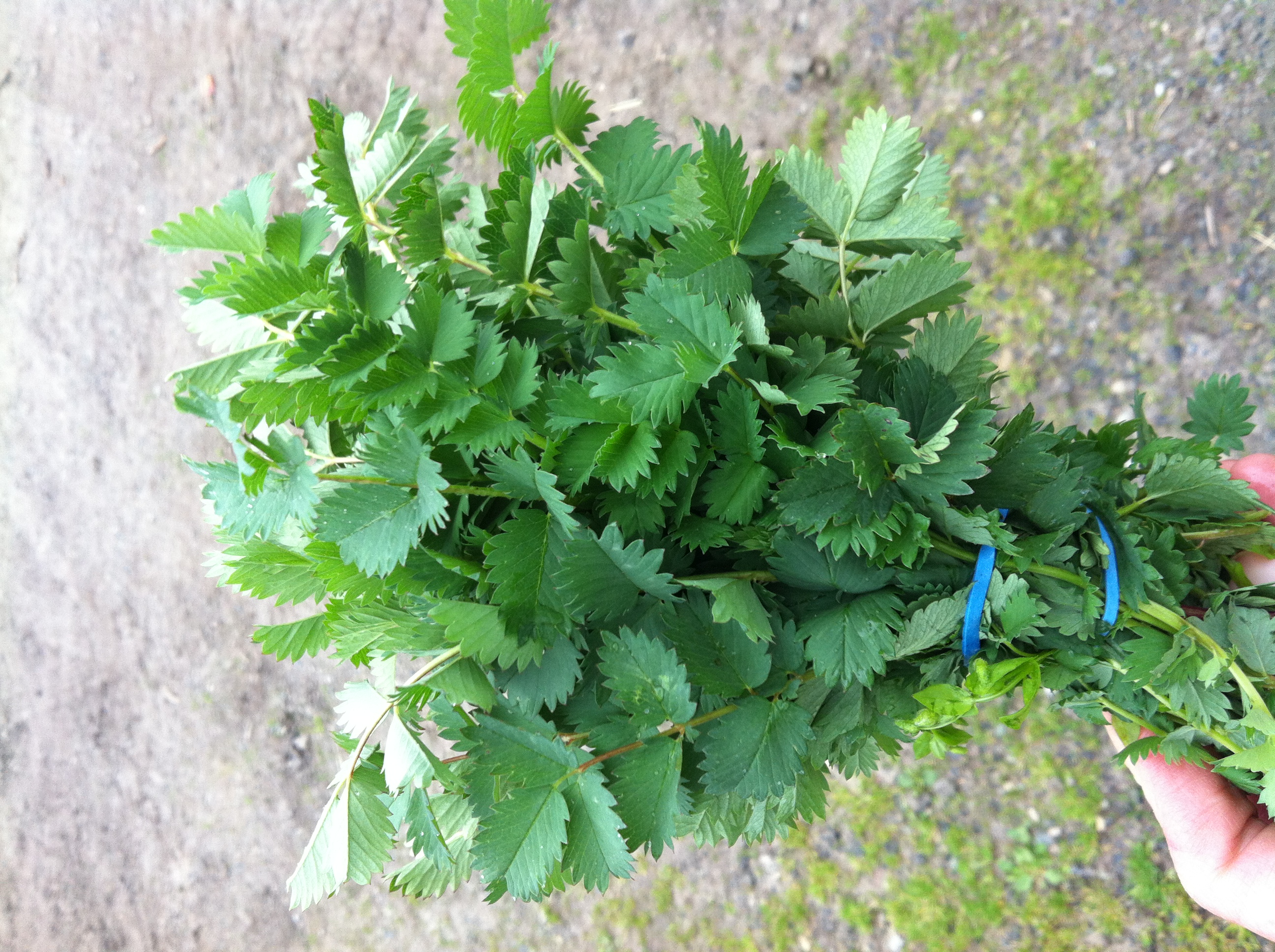
What looks like a leaf, but tastes like a cucumber? Salad Burnet!

THIS WEEK’S SUBSCRIBER MENU:
• “Lacinato” Leafy Kale
Cabbage “Broccoli”
• Swiss Chard
Green Garlic
• Salad Mustards
• Salad Burnet
• Radishes
Pea Shoots

Click on the links above for information and recipes about these crops.

COMING SOON:
Purple Radishes

This week, the first of our greenhouse crops are ready. The French Breakfast Radishes are peeking out of the ground, begging to be plucked and eaten. Mild, sweet, and pretty! Part of the salad crop we planted is ready before the lettuce, and it tastes delicious—nutty, mild, and with slightly pungent bites. Should be delicious as a salad with the pea shoots and a peanutty/Thai dressing.

These pretty radishes aren't just quick (21 days from planting). They're also sweet and mild.

The real mystery crop this week, though, is Salad Burnet. I’ve planted it for three years now, trying to figure it out. Finally, it has performed in a way to harvest. What fascinated me about this plant, reading about it in old vegetable books and seed catalogs, is that it doesn’t look like much, but it tastes…..like CUCUMBERS! What a welcome treat in early spring! I like it best fresh, in a sandwich or salad. Maybe on top of soup, but not cooked in it.

So make an amazing salad this week, from the mustards, pea shoots, and salad burnet, dressed with pretty radishes on top, and ENJOY SPRING! Tomorrow, sauté half of your green garlic with your cabbage sprouts in a little olive oil. Maybe toss it with pasta and Pecorino. That just leaves kale, chard and the rest of your garlic for—soup?

Spring Week 2: Signs of Spring

The first spears of our asparagus patch poking out to greet chilly air. We won't be able to harvest anything until next spring. The plants need all the energy they can get from the aerial parts.

THIS WEEK’S SUBSCRIBER MENU:
• “Siberian” Leafy Kale
• “Red Russian” Sprouty Kale
• Swiss Chard
• Spring Onions
• Purple Sprouting Broccoli
• Turnip Rapini, or “Broccoli Raab”
Sorrel

Click on the links above for information and recipes about these crops.

COMING SOON:
Pea Shoots
Salad Greens
Beet Greens 

The weather has been beautiful, mostly, for April. Remember last year? Frosty, rainy, even snowy—until mid-May? We couldn’t plant anything on time last year. Last week we got our early crops of carrots, beets, spinach, Yokatta-Na (and others), and peas done! And even the early cut-flowers! I think it’s going to be a good year.

The last windy week ripped the covers off of our first pea crop, planted in early March when it was sunny and dry, then protected with metal hoops and fabric to keep out frost and wind. Early peas this year!

There have been other signs of spring this week. We found our first hatch of renegade chicks. This hen hatches at least one brood every year. She’s very stealthy, we never know where she hides:

Our first hatch of the year! We found three stranded baby chicks by the hay shed, and had to search to find this mama. She had three with her in the bushes, but all were reunited successfully.

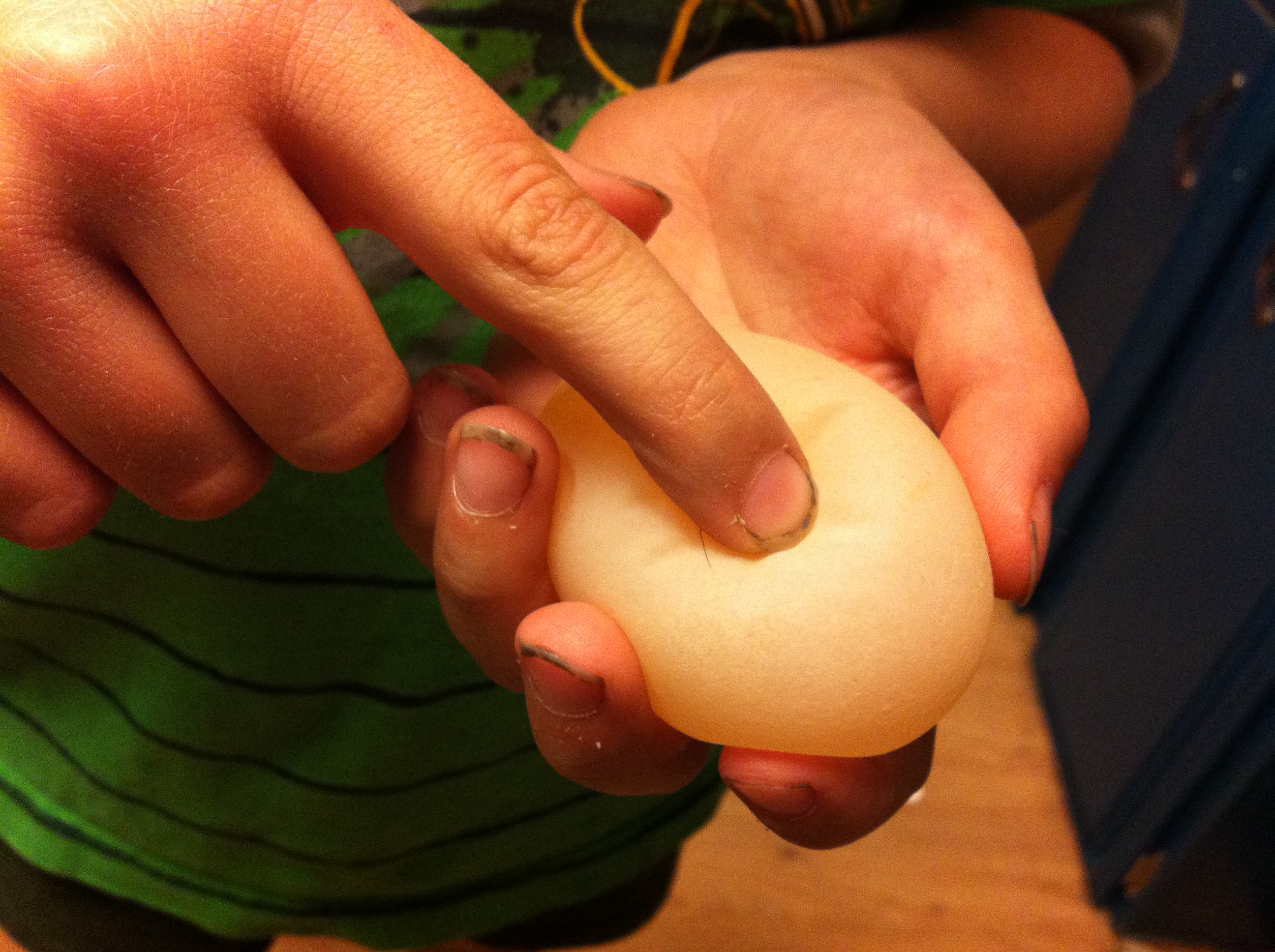
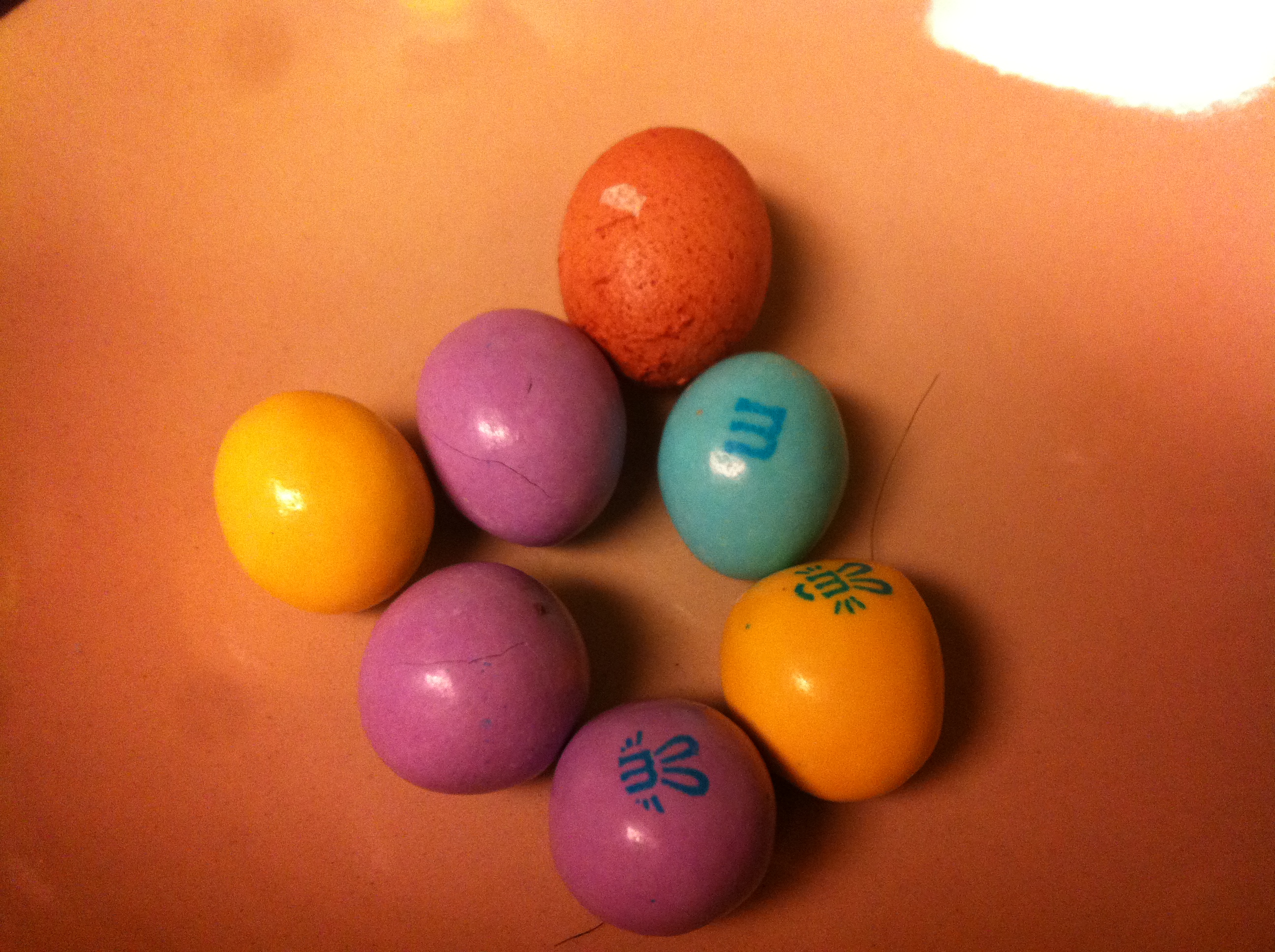
The new pullets are starting to gear up for laying, too. When the girls start out, they make a lot of practice eggs. Sometimes they’re funny shapes, sometimes not complete. Here are a couple that survived to be documented:

Sometimes, when chickens are just learning how to lay eggs, they make an egg without a shell. This one has the membrane intact, and is a complete egg inside, just no outer shell to protect it.

There's a tiny pullet egg at the top of the M&M's.

Spring Week 1! Loads of Greens

This week's greens, clockwise from top left: Swiss Chard, Purple Sprouting Broccoli, Turnip Rapini, Siberian Kale, and Sprouty Redbor Kale.

THIS WEEK’S SUBSCRIBER MENU:
“Siberian” Leafy Kale
• “Redbor” Sprouty Kale
Swiss Chard
Green Garlic
• Purple Sprouting Broccoli
Turnip Rapini, or “Broccoli Raab”
• Parsley

Click on the links above for information and recipes about these crops.

We have been anxiously awaiting the first week of the Spring Season for weeks, if not months. The replies to my email announcing the first pick up have been exuberant: “Yippee!”, “Can’t wait for those first greens!”

We were worried a few weeks ago that we wouldn’t be able to glean much for the first week. It was so cold and rainy. But the last week has made up for it—it’s been warm and sunny, and the overwintered crops have thrived. All of the brassica crops have burst into bud—and that means good eating. I love all of the “broccolis”—those flowering tops of “cole” plants. They all do it—make flowers, that is. My favorite is Cabbage broccoli—it’s sweet and tender. Kale broccoli are sweet, too, and you get those little tender leaves to eat with it. Kohlrabi broccoli are tasty, but slightly bitter. But turnip broccoli, or “Broccoli di Rapa” aka Broccoli Raab, is the most bitter. Bitter and sweet, and tender.

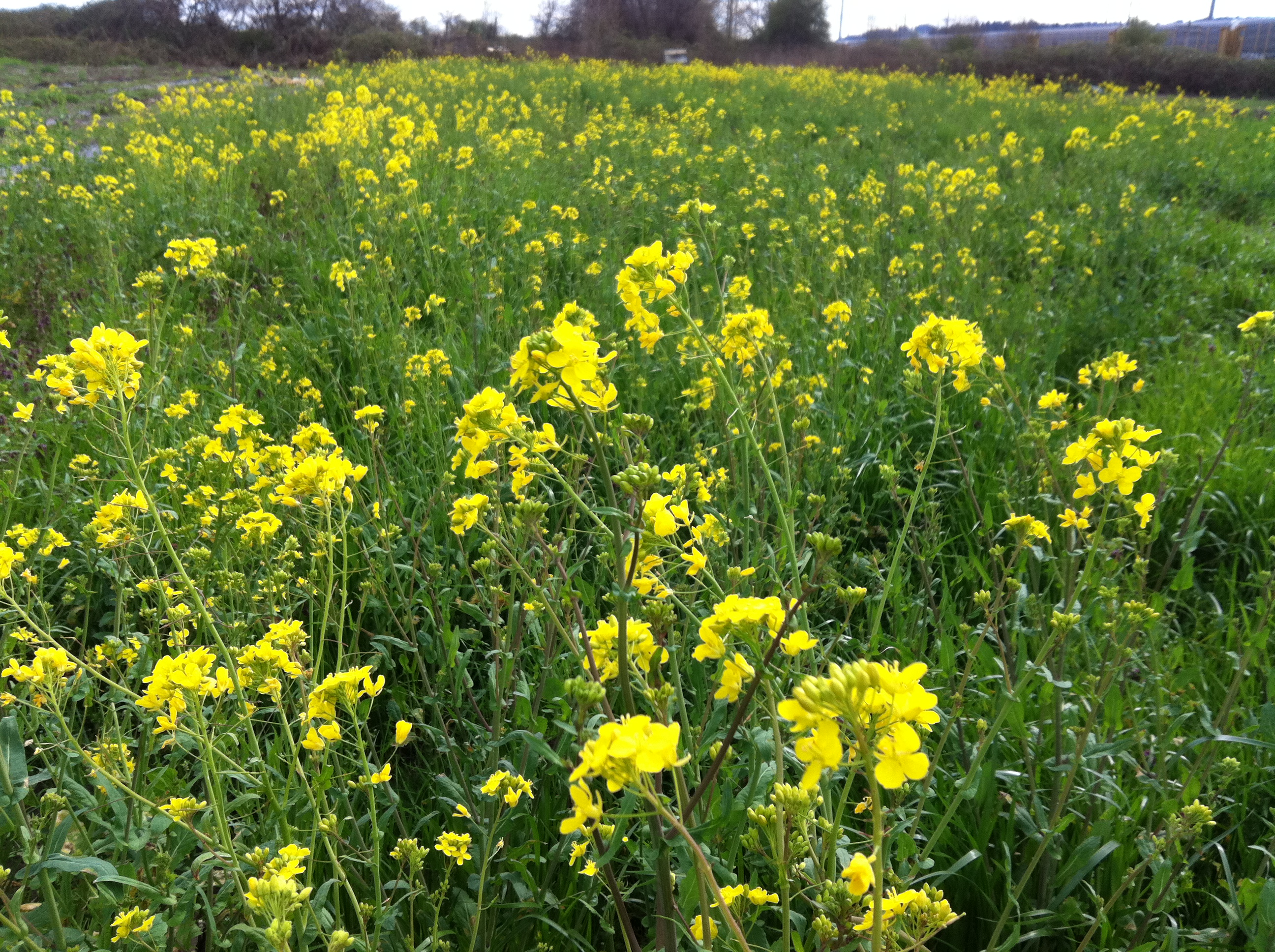
Follow the links above to find out more about cooking these spring delicacies. We had them all, and we share them with you this week. Because if the warm weather holds out, the broccolis will burst into yellow blooms like this:

Brassica Bee Fodder.

Spring is Near

This is a difficult time. The seeds have all arrived. The onion plants have arrived.  Waiting…

…..and the rain just keeps coming.

A few days without rain are all that are needed to start working up ground.

Last week was beautiful. Mike had the tractor out, discing to loosen up sticky soil made heavy by winter rain. This is the first step—cut into the top layer to open it up and let oxygen in, so the water can evaporate. And it works quickly, even if the temperature is not very warm. In three days last week all the puddles disappeared, the back field was nearly dry enough to prepare for potatoes, for that is where they will land in the rotation. Broccoli and cauliflower two years ago, winter squash last year. Now it will be potatoes’ turn.

One more day was all that was needed. And then the rain returned. And it’s still raining. While we were at Della’s first track meet, we stood soaked by the downpour and wishing it would stop.

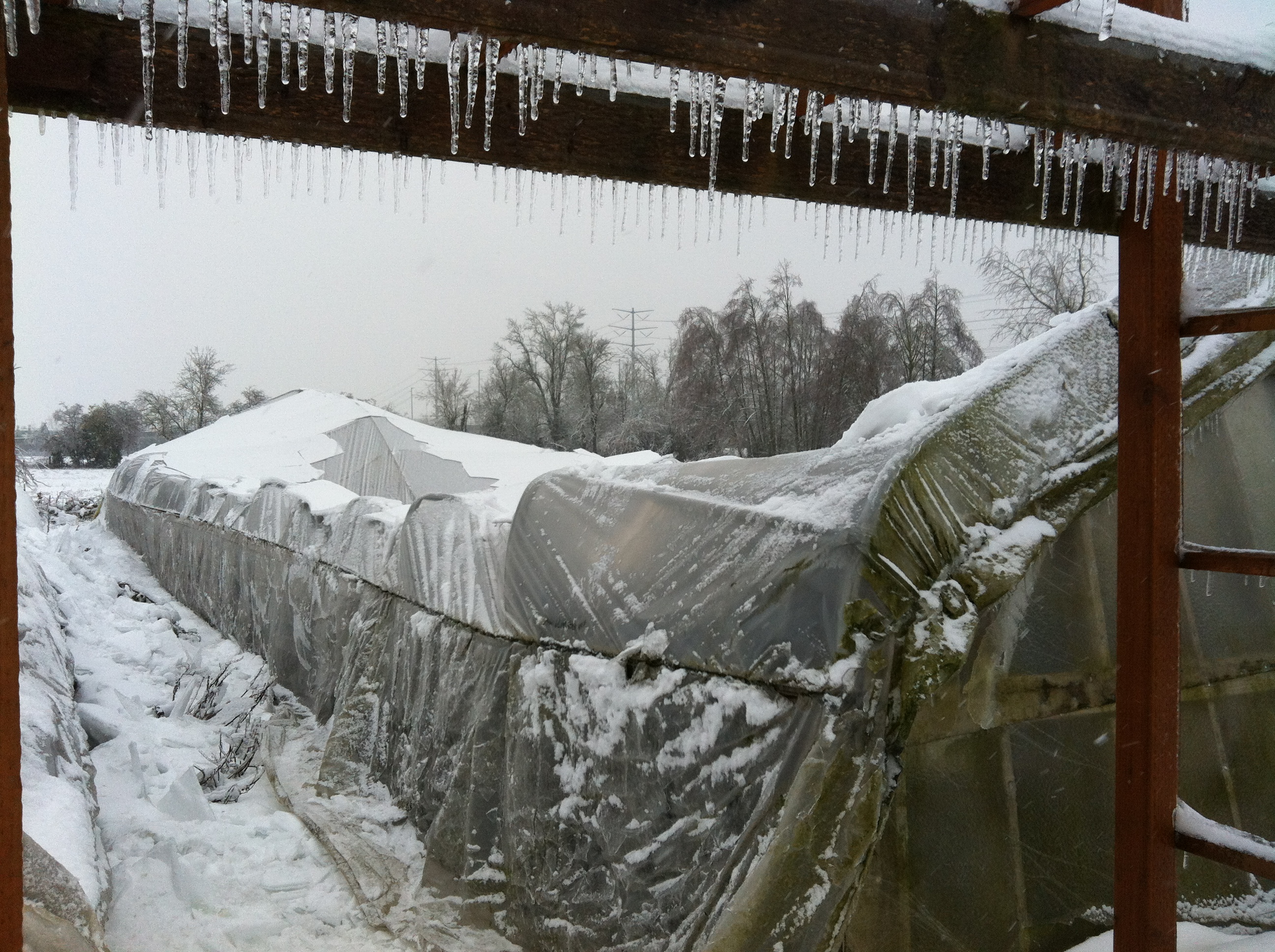
The January ice storm crushed all of our greenhouses.

After. Much better, the crushed arches replaced with heavier steel.

But all is not lost. The greenhouses are all repaired. The big one that we planted with carrots, beets, and salad greens is doing well. The next one that we planted in spinach and radishes is nearly sprouting. Inside, the temperature is at least 10° warmer, even if it’s cold and rainy. Even warmer if the sun peeks out. We can fabricate spring if we need to.

When we start harvesting next week for our Spring Season, we will have rapini, kale, green garlic, spring onions—all overwintered from last fall. Soon, the purple sprouting broccoli, spinach, pea shoots, and swiss chard will be ready to harvest.

My work begins in earnest now, to fill up Greenhouse #1, Arizona, with many, many flats of starts that we will plant out in 4-6 weeks. Lettuces, cabbages, scallions, those earliest broccoli and cauliflower—crops that will be ready for the end of Spring and beginning of Summer Season, late May-early June. Cucumbers will go in Greenhouse #2, California—those sweet, seedless, Persian cucumbers that we fell in love with last year. We didn’t lose our indoor cucumber plants in the short summer, unlike all of the outdoor cucumber plants that succumbed to the mysterious cucumber virus of 2011.

We started these pullets in November, so they'd be ready to lay eggs in April.

The pullets (young hens) we started last November are nearly ready to start laying. They will move into their new house this week, fitted with nest boxes and straw. Plenty of space to be comfortable. The older hens are picking up the pace now, just in time for Easter. Eggs are plentiful in the spring, but the hens need to be re-instructed on where to put them so that we can find them. This is the real Easter Egg Hunt, every day.

Winter Week 10: The End of Winter

A tidy pile of little Napa cabbages. Sweet and crispy, with just a hint of mustard.

THIS WEEK’S SUBSCRIBER MENU:
 “Delicata” Winter Squash
• “French Fingerling” Potatoes
Topless  Beets
Brussels Sprouts
Savoy Cabbage
• Turnip Greens
• “Lacinato” Kale
• Napa Cabbage
• Tatsoi
• Onions

Click on the links above for information and recipes about these crops.

OUR WINTER SEASON IS OVER. IT IS NOW OUR TIME TO REST, PLAN, AND CLEAN UP IN PREPARATION FOR THE NEW SEASON. SEE YOU IN THE SPRING!

We have made it through the 10 weeks of our winter season. There is a list of things we wish we’d been able to offer for winter, like parsnips, rutabagas, leeks, and more carrots. But we feel like this has actually been one of our best winters since we started! We didn’t have to cancel any weeks, we’ve had plenty—even if we ran out of carrots. There has been plenty of food.

We hope to see you all again in the spring and/or summer. We have great things planned—if we have another short growing season we will be prepared, and if we actually have spring and summer weather, the bounty will be truly abundant.

Have a wonderful winter, and thank you for your support of our family and our farm!

Shelley, Mike, Della, and Cosmo