Category Archives: Uncategorized

Aside

SPRING IS NEARLY HERE! OUR SUMMER SEASON STARTS IN JUST ELEVEN WEEKS!! ARE YOU READY?  2012 CSA information is here! CSA Application Form: CSAapp2012 CSA Brochure: 2012CSA brochure Check back or email me! for more information. IT’S GOING TO BE A GREAT GROWING … Continue reading

Winter Week 9: 3 More Minutes Every Day

Glory of Winter

THIS WEEK’S SUBSCRIBER MENU:
 “Baby Spaghetti” Winter Squash
• “French Fingerling” Potatoes
• Topless  Beets
• Turnip Greens
• Curly Kale
• Napa Cabbage
• Tatsoi
• Garlic

Click on the links above for information and recipes about these crops.

COMING SOON:
Brussels Sprouts
The End of Winter

Have you noticed? It is difficult to catch it when the days are dark and cloudy already, but we are gaining 3 extra minutes of daylight each day! Spring is on the way! Soon the plants will grow again, and the chickens will lay eggs. I’m tired already of buying eggs. The new pullets are coming along and are fully-feathered—they should be ready to lay in April.

The beet greens are not pretty any more, and there’s no point in trying to save the leaves when we harvest. The size doesn’t really  matter either. If they’re big I just cut them into chunks and roast them. The squashes may be little, but they are a true spaghetti. We think they’re tastier than the big ones too. Just bake at 350°, or microwave/steam, fluff out the strands of flesh and serve with pasta sauce or just good olive oil and parmesan. You can use Tatsoi just as you would Pak Choi or Baby Bok Choi. Sauté or stir-fry. It’s tasty and substantial.

We are already starting to strategize for next year. How to utilize the greenhouses more—we are actually going to get the ground worked up inside in the next week or two and start planting extra early. We want to have carrots, peas, spinach, and green onions in April when the Spring Season starts. We’d also like to have a little extra to start at farmers markets with something more than pea shoots and rapini.

I have been straining to think of what I can take a photo of today. It’s so wet and grey, there just isn’t anything that is inspiring me. Instead I scrounged through my photo library. When it’s not raining, we can spend the winter pulling up plastic mulch. Enjoy this one:

Child Labor: Della was 3 and Cosmo was 2. Start them out young, we always say.

Winter Week 7: Soooo Cold! 9 days to Solstice

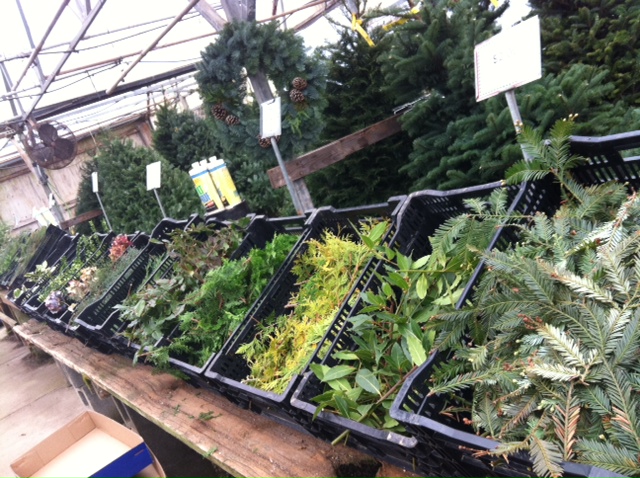
It has been our pleasure this winter to create a new Pickup Site in Skyway, at Minters' Earlington Nursery. I have to admit, I've done my share of shopping—I'm a plant junkie. And, I couldn't keep my mitts out of the Winter Greens Bar. Stop by and grab some greenery!

THIS WEEK’S SUBSCRIBER MENU:
“Baby Pam” Sugar Pumpkin 
• “Yukon Gold” Potatoes
Turnip Greens
• “Tendersweet” Cabbage
Mixed Young Chicories (Radicchio, Dandelion, Endive)
• Young Fennel
• Pepper Cress
• Yellow Onions

Click on the links above for information and recipes about these crops.
COMING SOON:
Brussels Sprouts
Red and Green Curly Kale
Shallots 

NOTE: CHRISTMAS IS AROUND THE CORNER, SO THIS IS ANOTHER DOUBLE HARVEST WEEK FOR WEEKEND PEOPLE. SATURDAY AND SUNDAY SUBSCRIBERS WILL GET TWO WEEKS WORTH OF PRODUCE ON THE 17th and 18th, AND THERE WILL BE NO PICKUP ON DECEMBER 24th and 25th.

Alas, the nights are ever-lengthening, and the mornings are colder each day. It didn’t thaw until 11:00 this morning. This is no great problem, except that most vegetables can’t be picked while frozen or they don’t wake up. They will thaw and be a wilted product that looks cooked. Freezing punctures the cell walls, and the plant structures soften. However, just about everything that is left in the field can handle freezing and thawing just fine, provided that they are thawed when harvested.

Last week we used up the remaining small lettuce plants, because the closer the thermometer gets to 20°, the less likely they are to recover. This week, the fennel is suffering. We decided to pick it, even though it is small and looks damaged because the flavor is still there and should taste good in a salad, soup, or other dish. Use it quickly though.

The chicories also are going to start seeing some damage, and they won’t mature in the spring before they bolt in the increasing daylength, so out they come. We thought that a mix of reds and greens would be nice with a touch of fennel and peppercress for a winter salad.

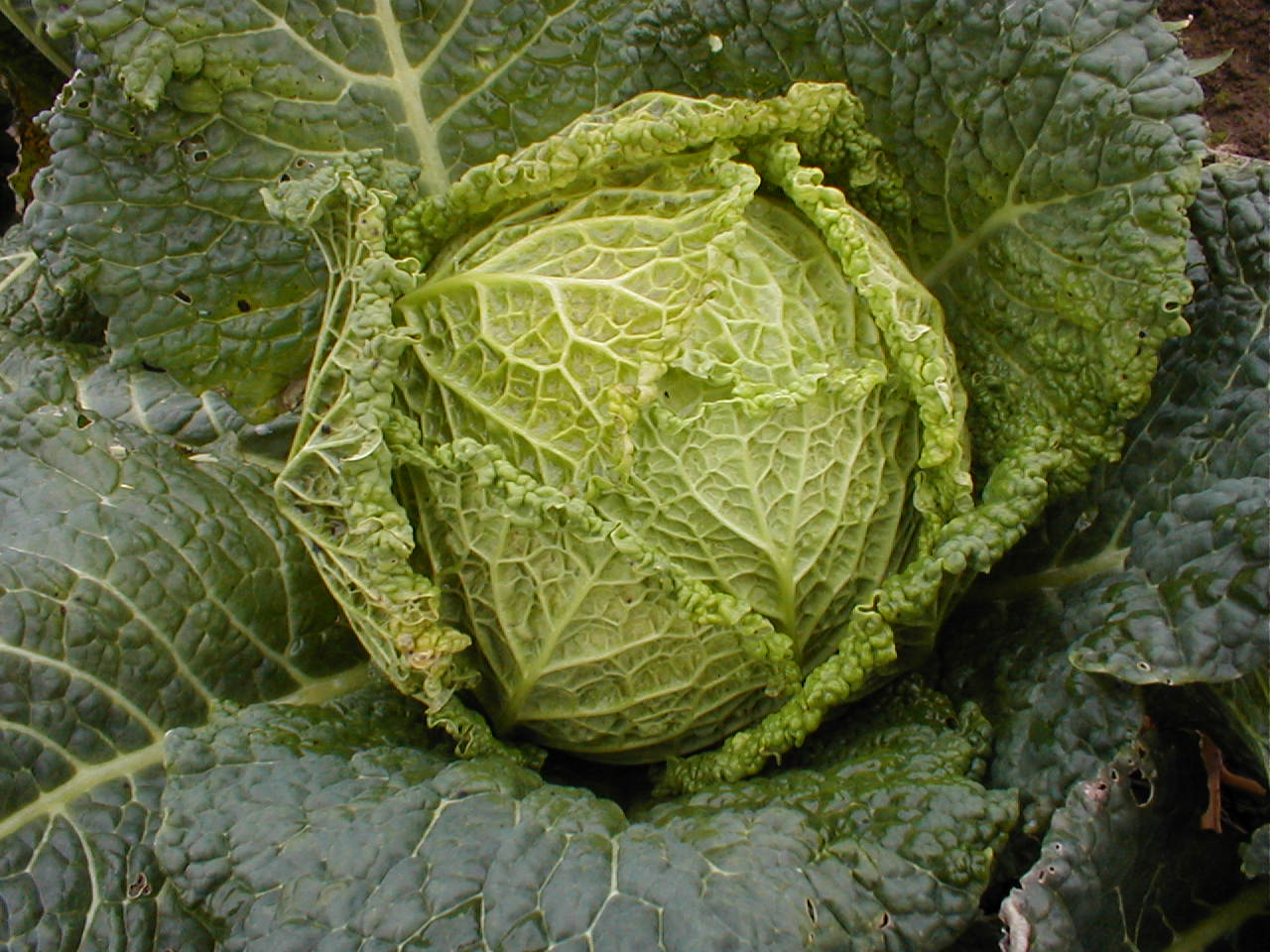
Turnip greens are a sturdy cousin of mustard greens. A little more substance, and a nutritious tasty vegetable. “Tendersweet” is a special cabbage, not particularly cold hardy, and ready now, so they were chosen this week. Thin, sweet leaves and a flattened head—these are tasty raw, or steamed or sautéed.

Winter Week 6: Cold and Dark—Countdown to Solstice

THIS WEEK’S SUBSCRIBER MENU:
Various Winter Squashes
• “All-Red” Potatoes
Golden Beets
Mustard Greens
• Kohlrabi
Swiss Chard
• Pepper Cress
• Red Onions

Click on the links above for information and recipes about these crops.
COMING SOON:
Brussels Sprouts
Red and Green Curly Kale

I will create a page for Kohlrabi tomorrow, and more information on Pepper Cress. Basically, peel the kohlrabi and eat slices of it raw with a little salt, or sauté it in butter or olive oil. Pepper Cress tastes a lot like watercress, and it adds a peppery bite to a sandwich, salad, or on top of soup. More to come….

Winter Week 5: Finding Joy

THIS WEEK’S SUBSCRIBER MENU:
• “Festival” or “Kabocha” Winter Squash
Beet(s)
Salsify
Collard Greens
• Baby Bok Choi
• Arugula
• Assorted baby heads of Lettuce
• Yellow Onions
• “D’Anjou” Pears from Cliffside Orchards in Kettle Falls

Click on the links above for information and recipes about these crops.
COMING SOON:
Mustard Greens
Peppercress
Brussels Sprouts

Operating a farm is a challenge, most people understand that. Running a business   based on customer contact and dependent on good customer service is a complicated layer to add to any business. Farming would be easier if we didn’t ever talk to our customers, or work hard at keeping them happy. Farming would be easier if we grew corn or soybeans. But that’s not what we do. We enjoy finding new food plants and growing them. We enjoy getting to know the people we feed. We enjoy knowing about their lives and families, helping them try and learn about new vegetables that they may never have seen. And we are happy when they are happy.

Farmers markets are good for us because we get a good sense of how people feel about things. In a quick snippet of conversation we can find out if someone likes or dislikes something, or they are turned off by a pink beet or a speckled lettuce. Then we can decide if it’s worth pursuing or if it’s too much of a struggle to “sell”. If someone has a bad experience because their basil went bad in the fridge, we can give them another bunch and encourage them to try again before they give up on it, for example.

We have been operating a CSA for many years. This is our 14th year, actually. The first few years were a huge learning experience. Guessing and learning what people like each week, learning how to handle the instances when people didn’t like what was in their box. Learning how many weeks in a row we can get away with giving everyone beets instead of tomatoes. In those 14 years we have figured out what quantity is about right for a family every week. We’ve figured out that people generally want certain things every week—like onions and/or garlic. That many people want salad greens every week, but many people don’t like kale every week. When we pack shares for delivery, we have to consider what the average prefers. When people pick up at the farm or a farmers market, we can offer choices.

We rarely get comments from customers, and we have learned that, generally, as long as people aren’t complaining, they are probably happy. Of course, when we get a compliment, we are thrilled! I’m not fishing for compliments, but it sure does make our day to get one. When someone complains, it is agonizing. We have to remind ourselves that just because one person complains, it doesn’t mean everyone is unhappy. Then occasionally, we have a customer who consistently finds something to complain about. My first instinct is to try and fix it. But sometimes, there is just nothing that can be done, because they just want to find things to complain about.

For instance, we have some amazing brilliantly-colored beets right now. Some of them are huge—well over a pound each. Some of those single beets probably outweigh a standard bunch of beets. When I saw them this morning as we were packing boxes, I was in awe. “Those are amazing!” I exclaimed. Mike wasn’t sure what to do. 99% of our subscribers wouldn’t be able to use more than one in a week. And they are just so beautiful, we should share them with everyone, so we gave many of the boxes just one glorious, luminous beet. Last week we shared Cliffside Orchard’s delicious pears with all of our subscribers. We had one box leftover this week, so we thought we would pass them on to everyone, even if it meant just one per box. I didn’t expect to hear a complaint that there was only one pear in the box. If I had known anyone would be horrified about getting one pear, I would have kept them and eaten them myself, or fed them to the pigs.

We have a pretty humble, simple life. We find joy in making people happy, and growing good food, and watching our customers’ children grow up strong and healthy, and then seeing them buy their own vegetables. We find joy in the incredible color of a technicolor beet, or the supreme juiciness in a truly ripe D’Anjou pear. And we find joy in sharing these simple, amazing things with our family of customers.

Winter Week 4: Ready for Thanksgiving

Rugosa Rose Hips are even more brilliantly scarlet when iced with frost.

THIS WEEK’S SUBSCRIBER MENU:
“Baby Pam” or “Winter Luxury Pie” Eating Pumpkin
• Japanese Baby White Turnips
• Sweet Winter Spinach
• Arugula
• Italian Parsley
• Assorted baby heads of Lettuce
• Garlic
• “D’Anjou” Pears from Cliffside Orchards in Kettle Falls

Click on the links above for information and recipes about these crops.
COMING SOON:
Mustard Greens
Collard Greens
Peppercress

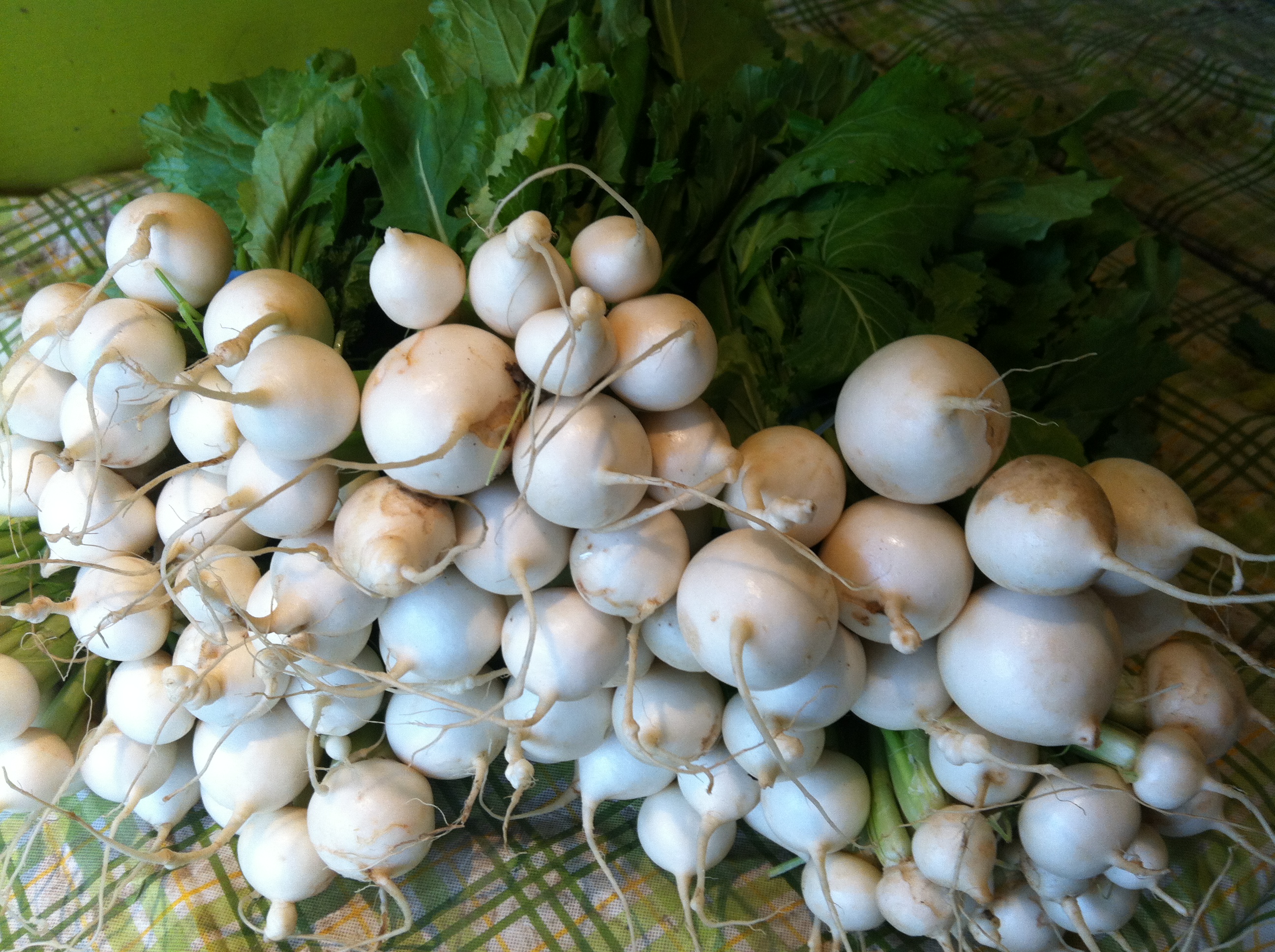
Japanese Turnips are almost a vegetable separate from the standard turnip world. They are tender, crunchy, mild, and sweet. And snow white.

This week is Part Two of the Thanksgiving share. Those who pick up on Saturday or Sunday picked up all the produce from Week 3 and Week 4 simultaneously so that we can have our holiday on the Saturday after Thanksgiving. It’s a large amount of food to get at once, but we try to include plenty of things that will store for that second week. If in doubt, you can top the root crops and store them in a plastic bag in the fridge for several weeks, as well as the cabbage. Garlic and onion should keep, and the squash will definitely keep, or you can go ahead and cook it and freeze the flesh for later.

The lettuce is small, but we thought you’d like a Thanksgiving salad, and we were afraid we’d lose it all if the weather turned icy for more than a day. So better to use it than lose it. We have also included tender, sweet spinach and arugula to make a lovely salad for the big day. Throw in a slice pear to that salad as well, and toast the pumpkin seeds and add to the salad. The “Table Queen” seeds from week 3 can also be eaten.

We hope you all have a wonderful Thanksgiving, full of time with family and friends. Every day we are thankful to our devoted subscribers who believe in us and support us so that we can keep farming in our urban corner of the world.

THANK YOU!

Winter Week 3: Rainbow Vegetables

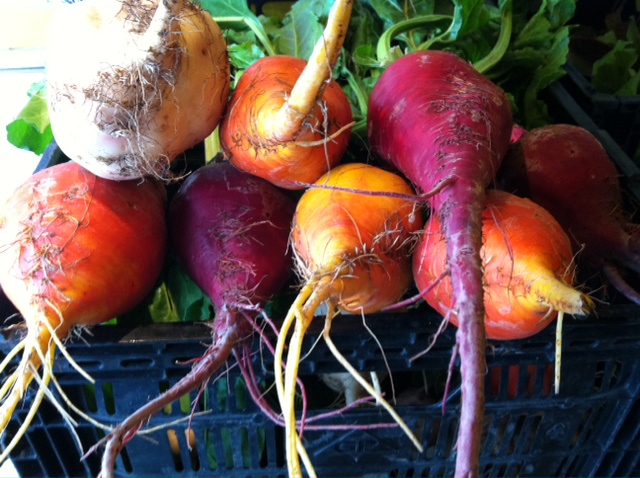
These should be called "Rainbow Beets". But they're actually a contrived "genepool", not really a variety, called 3 Root Grex.

THIS WEEK’S SUBSCRIBER MENU:
• “Table Queen” Winter Squash
• “Chioggia” or “3 Root Grex” Beets
• Carrots
• “Beira” Portuguese Collards or “Rainbow Lacinato” Kale
• Baby Bok Choy (aka Pac Choi)
• Cabbage
• Assorted baby heads of Lettuce
• Red Onions

Click on the links above for information and recipes about these crops.”T
COMING SOON:
Cliffside Orchard “Danjou” Pears
Arugula
Spinach
Japanese Turnips
Peppercress
Pie Pumpkin

We’ve been experimenting with our winter vegetables. Back in July we planted our fall/winter roots and sowed a new genepool along with our tried-and-true red, gold, and striped varieties. “Three Root Grex” is not really a variety, because it is a combination of three varieties of heirloom beet: “Yellow Intermediate”, “Crosby Purple Egyptian”, and “Lutz Saladleaf”. The gigantic leaves are definitely from the Lutz parent, we’ve grown those before. They also grow huge roots if given enough time before dark winter arrive. The cone-like, tapered shape is reminiscent of the more primitive beets—spherical beets are a new development. What we end up with is a jeweled mix of huge, beautiful beets. Enjoy them! We’ll be planting again next year.

New to our greens repertoire this year are two varieties: “Beira Tronchuda”, rumored to be a type of collard from Portugal. It’s an open-headed cabbage with thick, white ribs, and is supposed to be very cold tolerant, but I don’t know that it gets too cold in Portugal. Another experiment is “Rainbow Lacinato” Kale. Also more of a genepool than a variety, it’s a combination of Red Russian and Lacinato (Dinosaur) Kales. I’m not seeing a lot of rainbow-ness, but it is definitely covering the pink-purple-blue range in the kale spectrum for us.

“Table Queen” squash looks like an Acorn or Danish type. It too is an antique, not resembling the new black Acorn descendants. This one actually fruits up white to pale green and darkens as it ages. I don’t like Acorn squash—I find them boring and bland. But this one is different. It isn’t sweet (like other Acorns) but it IS nutty, like what I would imagine an acorn to taste like. Plenty of nutty, not sweet flavor to justify being grown for centuries.

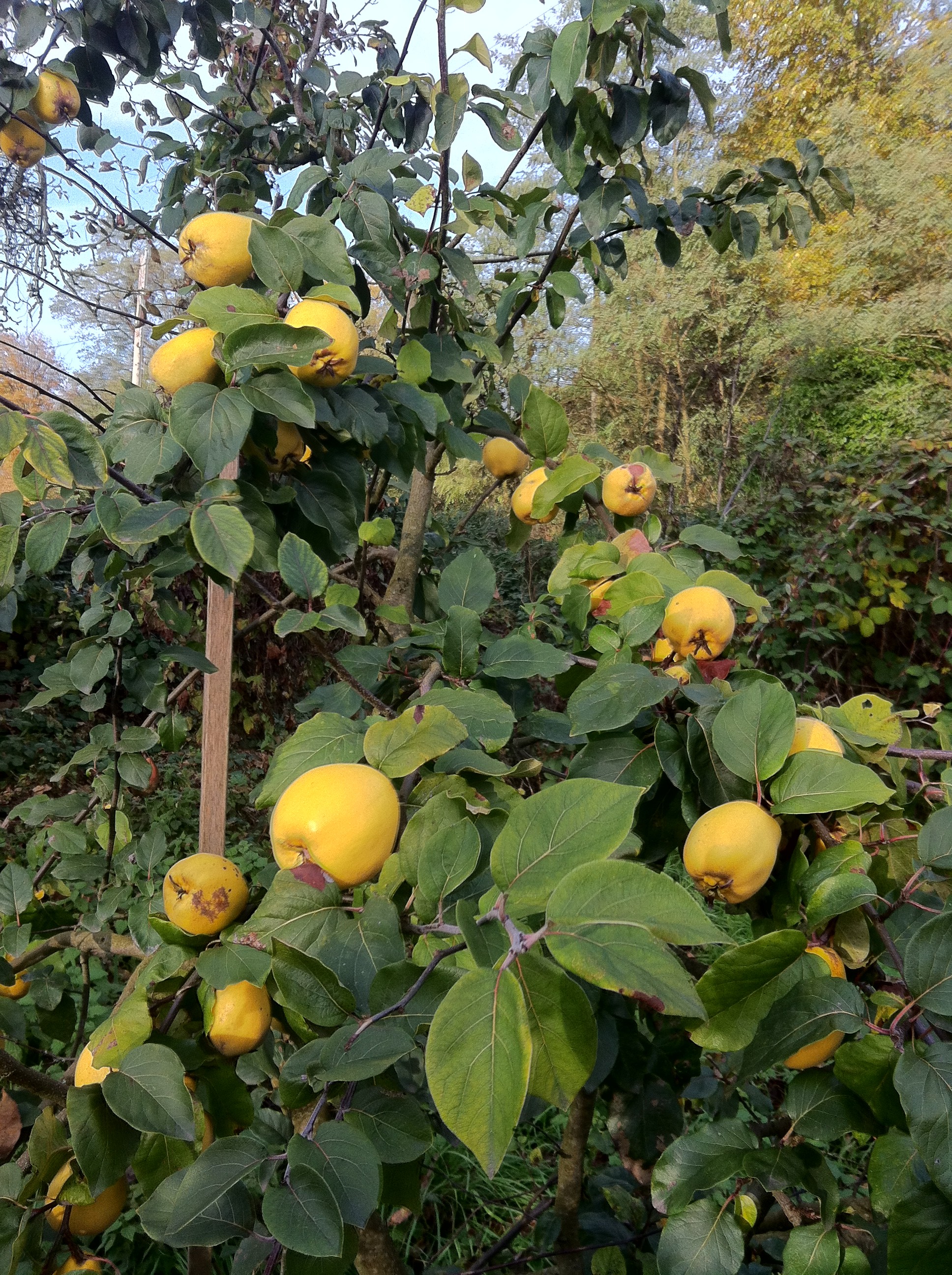
You need Smell-o-vision to really get a sense of what the elusive Quince is all about. Reminiscent of pineapples and a perfume like pears, when they're ripe they fill a room with scent.

Our Quince trees have produced  their largest crop yet. We planted the trees 6 years ago, and this year we harvested about 250 pounds. If you would like some let us know.

Beautiful jewels of Quince on our young trees. No broken branches this year.

Thanksgiving is next week, and we want to make sure you understand our schedule for these two weeks. We will do our usual pick-up/delivery schedule for Tuesday and Wednesday, but we have a more generous allotment for Saturday and Sunday pickup. There will be no pickup on the Saturday/Sunday after Thanksgiving. We are giving you two weeks of produce this weekend instead.

Have a wonderful holiday! We are so grateful to all of you who continue to have faith in us in providing food for you, and we are continually flattered that you choose us to feed your families.

Winter Week 2: White Roots and Green Leaves

THIS WEEK’S SUBSCRIBER MENU:
• “German Butterball” Potatoes
• “Kabocha” Winter Squash
• White Beets
• Baby White Japanese Turnips
• Red Russian Kale or Swiss Chard• Arugula
• Baby Green Romaine Lettuce
• Italian Parsley
• Garlic

Click on the links above for information and recipes about these crops.
COMING SOON:
Cabbages
Arugula
Baby Bok Choy
Pepper Cress

I will write more tonight, but here is the list of items you recieved/will receive this week. Kabocha squash is very dry and sweet, like chestnuts. It can be roasted in halves, or cut into cubes and roasted or steamed. I prefer to bake it over water or steam it because I don’t like the very dry texture, I prefer it creamier, even though the flavor is rich and sweet. It can also be cut into thin slices and baked or fried—popular as a tempura item in Japanese cooking.

The baby turnips are unlike a traditional turnip. They are somewhere between a radish and turnip and can be eaten raw with the greens. They can also be chopped with the greens and sautéed at this tender, tiny size. Yes, eat the greens too, raw or cooked.

This the first year we’ve had white beets that get to a decent size. This week Teo picked the “smallest” he could find. Yes, there must be beets out there the size of a human head. They are milder than red beets, and won’t stain. In our family taste test of beets, we found them the least sweet of all of our varieties. See what you think! And make sure you eat the greens!

Winter Week 1: First Flash of Frost

The Halloween Bridal Party!

THIS WEEK’S SUBSCRIBER MENU:
“Delicata” Winter Squash
• Red, Golden, or Chioggia Beets
• Carrots
Siberian Salad or Red Russian Kale
Brussels Sprout Tops
• Yellow Onions
• Red Romaine Lettuce
• Fresh Thyme

Click on the links above for information and recipes about these crops.
COMING SOON:
Potatoes
Cabbages
Arugula
Baby Bok Choy
Japanese Turnips

Halloween is past, and the season of darkness is upon us. Then hens let us know by shedding their feathers and giving up on egg-laying. It’s time for them to sleep and rest. The cows are (hopefully) bred, and incubating calves that will be born in April and June. I’ve got all my fingers crossed. And all my toes are crossed that both sows, Bess and Lillibet are pregnant as well, and will be fat with baby pigs this winter—they should be due in February. Next year’s flock of laying hens will arrive in two weeks—perfect timing, because they will be mature in 6 months and ready to lay as the days get longer in May.

We had a pretty hard frost this morning. Enough to blanket everything in white. Hopefully enough to sweeten up the greens and send plant sugars to the roots of carrots and beets. Plant sugars are like antifreeze, and that is our reward for waiting until cold weather to eat them. Nothing satisfies me like frost-sweetened kale sautéed in garlic. Mmmmm.

We are using up the last of our summer lettuce patch this week—a red romaine named “Marshall”. Maybe two more weeks of growing time would have filled out the heads, but the color is amazing, and it doesn’t seem to handle freezing well, so might as well pick it.

But you might ask, what are Brussels Sprouts Tops! I might have to share this mysterious vegetable with you, because it’s one of our novelty crops! Brussels Sprouts are basically a cabbage that grows with an elongated stem, and the little sprouts grow in each of the leaf-stem joints. When the bottom sprouts reach 1/2″ in diameter, we decapitate the plants. Very gory, I know. The fluffy, leafy top is delicious, though, and can be eaten like Kale or Collard Greens, its’ cousins. This is basically a way of pruning the plants so that all the sprouts size-up at the same time, instead of having big sprouts on the bottom and tiny ones on top, which is the plant’s preference. Maniacal Plant Mutilation and Manipulation.

The turkeys are much happier in their warm, dry greenhouse. Three weeks to Thanksgiving!

The turkeys are getting big, and we finally got them into an empty greenhouse for their remaining few weeks of life. At least it’s warmer and dry in there. And no risk of losing them to predators, or flight. Yes, they are amazing flyers even though they are heavy. All it took was one airborne turkey to teach us to keep them completely enclosed. I watched in awe as it took off and glided effortlessly around the farm—really nearly as big as an eagle—never to be seen again.

Summer Week 20: End of Summer

This is the time of year when honey robbing takes place. We've put entrance reducers on the bee hives so the girls have less doorway to guard and defend. But here you can see two dead yellowjackets and one dead honeybee. The casualties of war.


THIS WEEK’S SUBSCRIBER MENU:
• “German Butterball” Potatoes
“Baby Pam” Sugar Pumpkin
• Broccoli
• Napa Cabbage
Collard Greens or Swiss Chard
Red, Golden, or Chioggia Beets
Sorrel
• Garlic

Click on the links above for information and recipes about these crops.
COMING SOON:
Carrots
Winter Squashes
Cabbages
Cauliflower 

The Summer Season has come to an end. It’s been a hard season for us. The late, late spring and lack of summer heat made growing tricky. Our winter squash yield is 1/3 of what it was last year, and last year wasn’t great either. What is the solution? More greenhouses or less squash? We will decide this winter, but I really enjoy eating squash in the winter, so it’s not a hard choice. We have the biggest crop of roots that we’ve had in years though, and a beautiful crop of broccoli that we will be able to harvest for several more weeks. And a big cabbage patch, full of swelling….cabbages.

We hope you’ve enjoyed the summer season, and if you’re not continuing on with us through the winter season, we hope you will be back next season. Every year we learn more, and every year there are new challenges. This is the ongoing learning experience that is farming.

Then hens aren't laying anymore. They are molting, and therefore are becoming naked. How can you lay eggs when you're losing all your feathers?

The hens haven’t laid an egg in weeks. They are molting. I like to think of it as genetic memory—just like their migrating relatives, they need to shed their old feathers in the fall and grow a new, strong set. Growing feathers takes a lot of energy and protein—what are feathers but protein? Eggs are protein, too, and a girl can’t make feathers and eggs at the same time. Besides, why would you want to hatch babies in the coldest part of the year. And that is what egg-laying is all about. Making babies. So, usually there are few eggs in the fall and winter, unless you leave the lights on them all day and night.  But then they never get a rest, and they burn out. But watch out in the spring, because they come back from egg-laying vacation ready to make up for lost time. Then we eat eggs every day.

If you still have an egg punch card, you can keep it and use it next spring. They don’t expire. If you really need a refund, we’ll be able to take care of it in February.